Listado de la etiqueta: wti
Precios del barril de petróleo cotizan a la baja
/en News«Los precios del crudo en los mercados energéticos iniciaron la semana a la baja, pero siguen por encima de la barrera de los 50 dólares, en una jornada de escasos movimientos por el feriado de Pascua en Europa.
El barril de petróleo tipo Brent del Mar del Norte para entregas en junio se cotizaba en 55.51 dólares al inicio de la sesión de hoy (08:00 GMT) en el mercado electrónico Intercontinental Petroleum Exchange (ICE).
El Brent perdía 38 centavos de dólar (0.68 por ciento) respecto al cierre previo, de 55.89 dólares por barril.
En tanto, el crudo estadunidense West Texas Intermediate (WTI) para entregas en mayo, también a las 08:00 GMT, caía 38 centavos de dólar (0.71 por ciento) y se cotizaba en 52.80 dólares por barril.»
NTX/I/GBM/JEH / Notimex
2017-04-17 05:01:37
Precio de petróleo a la baja pese a posibilidad de mantener recorte
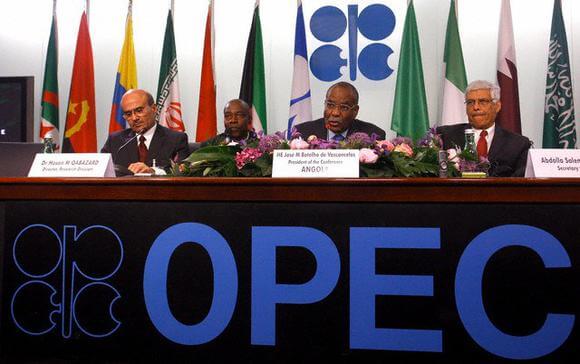
/en NewsLos precios del barril de petróleo mantenían este lunes su tendencia a la baja, a pesar del acuerdo de varios miembros de la Organización de Países Exportadores de Petróleo (OPEP), de recomendar al cartel que extienda su acuerdo de recorte de la produción.
La tendencia de este lunes cumplía tres semanas consecutivas, sin que se disipe el temor de que el recorte de producción aplicado por el cartel de productores desde principios de año sea insuficiente para reducir el exceso de oferta en el mercado.
La OPEP y 11 productores fuera del organismo que pactaron la reducción de la producción de crudo, entre ellos Rusia, siguen respaldando el cumplimiento de ese acuerdo, que prevé retirar 1.8 millones de barriles diarios del mercado durante los seis primeros meses del año.
Este fin de semana Algeria, Angola, Irak, Kuwait y Venezuela acordaron recomendar a la OPEP en su reunión del próximo 25 de mayo, mantener el recorte seis meses más, bajo el argumento de que las existencias de crudo se encuentran altas, indicó un reporte del sitio especialñizado Bloomberg.
En tanto, las reservas de petróleo en Estados Unidos, el mayor consumidor de crudo del planeta, se encuentran en un nivel récord para esta época del año.
El barril de petróleo tipo Brent del Mar del Norte para entregas en mayo se cotizaba en 50.65 dólares al inicio de la sesión de hoy (08:00 GMT) en el mercado electrónico Intercontinental Petroleum Exchange (ICE).
El Brent perdía 15 centavos de dólar (0.30 por ciento) respecto al cierre previo, de 50.80 dólares por barril.
En tanto, el crudo estadunidense West Texas Intermediate (WTI) para entregas en mayo, también a las 08:00 GMT, caía 31 centavos de dólar (0.65 por ciento) y se cotizaba en 47.66 dólares por barril.
Por su parte, la canasta de la OPEP se cotizó el viernes en 48.26 dólares, pérdida de nueve centavos de dólar (0.19 por ciento) respecto al cierre previo, informó el cártel.
Notimex
2017-03-27 04:53:07
Petróleo abre en ligera alza hasta los 48.31 dólares por barril
/en Sin categorizarEl precio del petróleo abrió en ligera alza este martes en Nueva York, en un mercado sin certezas ante las perspectivas de oferta de la Organización de Países Exportadores del Petróleo (Opep) y Estados Unidos.
Hacia las 13:00 GMT, el precio del barril de «light sweet crude» (WTI) ganaba nueve centavos hasta los 48.31 dólares en el contrato para entrega en abril del New York Mercantile Exchange (Nymex).
A las 11:18 GMT, el crudo Brent, el referente internacional para el petróleo, subía 36 centavos, a 51.98 dólares por barril, en un repunte desde un mínimo de tres meses de 50.25 dólares por barril, pero muy por debajo del nivel de enero de más de 58 dólares por barril tras los recortes de producción.
AFP / El Economista
Mar 21, 2017 |7:36
Crudo aprovecha debilidad del dólar
/en NewsEl petróleo subió el viernes gracias al debilitamiento del dólar y cerró una semana de vacilaciones atribuidas a temores por el futuro de la oferta.
El barril de light sweet crude (WTI), para entrega en abril, ganó 72 centavos a 53.33 dólares en el mercado de Nueva York.
En la plaza de Londres, el precio del Brent del mar del Norte subió 82 centavos a 55.90 dólares.
Tim Evans, analista de Citi, dijo que los intercambios de la jornada tendieron a un “prudente reequilibrio” luego de la fuerte caída de más de un dólar del jueves.
El crudo fue golpeado en la sesión previa por el pesimismo sobre el cumplimiento de los compromisos de reducir la producción que habían iniciado la Organización de Países Exportadores de Petróleo (OPEP) y Rusia.
En el balance semanal, el crudo acumuló una leve baja pero se mantiene desde fines del 2016 en un rango de precio de más de 50 dólares.
En ese contexto “el debilitamiento del dólar (..) ayudó a sostener el mercado”, indicó Evans.
El billete verde, cuya fortaleza pesa sobre los precios petroleros debido a que se fijan en esa moneda, perdió terreno este viernes por tomas de beneficios y porque la presidenta de la Reserva Federal, Janet Yellen, consideró posible que las tasas de interés estadounidenses suban este mes, lo cual, en teoría, vigorizaría al dólar.
Mezcla mexicana, en 45.43 dólares
En este cierre de semana, el crudo mexicano de exportación registró un incremento de 24 centavos, en comparación con la sesión pasada, al venderse en 45.43 dólares por barril, informó Petróleos Mexicanos.
Banco Base indicó que el petróleo finalizó la semana con pérdidas debido a que el aumento en la producción de inventarios de petróleo en Estados Unidos ha contrarrestado el esfuerzo de la OPEP de eliminar la sobreoferta mundial.
En lo que va del año, la producción de crudo en Estados Unidos aumentó en 2.99% (262,000 barriles diarios). A pesar de que el alza en la producción se encuentra muy por debajo al recorte que miembros de la OPEP realizan durante el año, las preocupaciones sobre el desequilibrio en los fundamentales aumentan.
información de AFP y Notimex / El Economista
Mar 5, 2017 |18:39
El barril de petróleo tipo Brent se cotiza en 56.25 dólares, al inicio de la sesión
/en NewsEl barril de petróleo tipo Brent del Mar del Norte para entregas en abril se cotizaba en 56.25 dólares al inicio de la sesión de hoy (08:00 GMT) en el mercado electrónico Intercontinental Petroleum Exchange (ICE).
El Brent perdía 37 centavos de dólar (0.65 por ciento) respecto al cierre previo, de 56.62 dólares por barril. En tanto, el crudo estadounidense West Texas Intermediate (WTI) para entregas en marzo, también a las 08:00 GMT, caía 40 centavos de dólar (0.74 por ciento) y se cotizaba en 53.46 dólares por barril.
Por su parte, la canasta de la Organización de Países Exportadores de Petróleo (OPEP) se cotizó el viernes en 53.23 dólares, lo que representó una ganancia de 47 centavos de dólar (0.89 por ciento) respecto al cierre previo, informó el cártel.
Copyright: El Sol de México
OPEC Convinces Investors That Its Oil Output Cuts Are Real
/en NewsOPEC appears to have persuaded investors that it’s making good on promised production cuts.
Money managers are the most optimistic on West Texas Intermediate oil prices in at least a decade as the Organization of Petroleum Exporting Countries and other producers reduce crude output. Saudi Arabia has said more than 80 percent of the targeted reduction of 1.8 million barrels a day has been implemented. Oil shipments from OPEC are plunging this month, according to tanker-tracker Petro-Logistics SA.
“All the signs are pointing to a pretty significant OPEC cut,” Mike Wittner, head of commodities research at Societe Generale SA in New York, said by telephone. “Until this week we were only getting data from the producers, now the tanker traffic seems to be supporting this view.”
OPEC will reduce supply by 900,000 barrels a day in January, the first month of the accord’s implementation, said the Geneva-based Petro-Logistics. That’s about 75 percent of the cut that the producer group agreed to make. Eleven non-members led by Russia are to curb their output in support.
Hedge funds boosted their net-long position, or the difference between bets on a price increase and wagers on a decline, by 6.1 percent in the week ended Jan. 24, U.S. Commodity Futures Trading Commission data show. WTI rose 1.3 percent to $53.18 a barrel in the report week. The U.S. benchmark slipped 1.1 percent to $52.57 at 10:52 a.m.
OPEC members Saudi Arabia, Kuwait and Algeria have said they’ve cut output this month by even more than was required, while Russia said it’s also curbing production faster than was agreed. Saudi Energy Minister Khalid Al-Falih said Jan. 22 that adherence has been so good that OPEC probably won’t need to extend the accord when it expires in the middle of the year.
Shale Headwind
The OPEC-engineered price rally has spurred a surge in drilling in the U.S. shale patch. Rigs targeting crude in the U.S. rose by 15 to 566 last week, the highest since November 2015, according to Baker Hughes Inc.
“There’s one headwind in the oil market: increased U.S. shale production,” Jay Hatfield, a New York-based portfolio manager of the InfraCap MLP exchange-traded fund with $175 million in assets, said by telephone. “U.S. output in 2017 will be 1 million barrels a day higher than last year.”
U.S. crude production climbed to 8.96 million barrels a day in the week ended Jan. 20, the highest since April, according to the Energy Information Administration. That’s already closing in on the EIA’s latest 2017 output forecast of 9 million barrels a day that was issued Jan. 10.
The net-long position in WTI rose by 21,429 futures and options to 370,939, the most in data going back to 2006. Longs rose 3.7 percent to a record high, while shorts slipped 11 percent.
In the Brent market, money managers reduced the net-long position by 3.1 percent to 448,352 during the week, according to data from ICE Futures Europe. Longs slipped, while shorts rose.
In fuel markets, net-bullish bets on gasoline fell 3.4 percent to 61,511 contracts as futures decreased 1.5 percent in the report week. Money managers increased wagers on higher ultra-low sulfur diesel prices by 1.3 percent to 34,978 contracts, while futures slid 0.4 percent.
“For the time being the market is more focused on the OPEC cuts than about how fast U.S. shale drillers are returning,” Wittner said. “There may come a point soon when the support provided by OPEC will be outweighed by the prospect of rising U.S. production. When that happens there will be a big shift in investor sentiment.”
Copyright: Bloomberg
Oil stays low ahead of Opec meet
/en NewsOil fell to its lowest in three months on Monday, as the prospect of another year of oversupply and weak prices overshadowed chances that Opec will reach a deal to cut output.
Donald Trump’s surprise win in last week’s US presidential election boosted the dollar and stocks but undermined oil. Crude has also fallen because of waning expectations that the world’s largest exporters will agree to reduce production this month.
Brent crude futures fell 50 cents on the day to $44.25 a barrel by 2:50pm GMT, while NYMEX crude futures dropped by 57 cents to $42.84 a barrel.
«In the same way that a strong Opec agreement was needed to continue the rally above $55, a lack of agreement will be needed to break below $40 and right now, we’re at $45,» Petromatrix strategist Olivier Jakob said.
Opec plans to cut or freeze output, but analysts doubt the group’s ability to reach an agreement at its meeting on 30 November.
Opec said on Friday its output hit a record 33.64 million barrels per day in October, and forecast an even larger global surplus in 2017 than the International Energy Agency (IEA) on Thursday.
Yet, Saudi Energy Minister Khalid al-Falih has said it was imperative for Opec to reach a consensus on activating a deal made in September in Algiers to cut production.
«Opec know what needs to be done but too few members will agree to take the production pain for the price gain, knowing also that the price gain incentivises non-Opec to produce more, lengthening the rebalancing process,» PVM Oil Associates analyst David Hufton said.
The dollar index hit an 11-month peak on Monday, driven by an aggressive sell-off in bonds that has pushed Treasury yields to their highest since January.
Ordinarily, a strong dollar would push oil lower, but the correlation between the two is at its most positive in two months, suggesting they are more likely to move in lockstep with one another than in opposite directions.
Data from the InterContinental Exchange on Monday showed investors delivered the largest weekly cut on record to their bets on a sustained rise in the price of oil.
Copyright: Up Stream
Oil Trades Near $44 as U.S. Election Sends Stocks, Dollar Higher
/en NewsOil traded near $44 a barrel in New York amid a broader market rally driven by speculation Hillary Clinton’s chances of winning the U.S. election increased after the FBI said her handling of her e-mails wasn’t a crime.
Futures rose as much as 2.1 percent in New York following the Federal Bureau of Investigation’s report. The S&P 500 Index was set for its biggest gains since June and the dollar rose against its peers for the first time in seven sessions. Russia, the world’s biggest energy producer, is “on board” with an OPEC agreement to limit crude oil production to help re-balance the market, according to OPEC Secretary General Mohammed Barkindo.
«The U.S. election is front and center in all the markets,» said Chris Kettenmann, chief energy strategist at Macro Risk Advisors LLC in New York. «There was talk over the weekend of Russia agreeing to limit production in cooperation with OPEC, but we need to see a resolution from the Nov. 8 vote before the focus shifts to Nov. 30.»
Oil retreated below $45 a barrel following the failure of the Organization of Petroleum Exporting Countries to agree on output quotas for member countries on Oct. 28, which must happen before a deal can be finalized. OPEC pumped at a record rate in October, according to data compiled by Bloomberg.
West Texas Intermediate for December delivery rose 32 cents, or 0.7 percent, to $44.39 a barrel at 11:26 a.m. on the New York Mercantile Exchange. The contract slid 59 cents to $44.07 on Friday, the lowest close since Sept. 20. Prices fell 9.5 percent last week, the most in almost 10 months.
Election Focus
Brent for January settlement rose 4 cents to $45.62 a barrel on the London-based ICE Futures Europe exchange. Prices declined 8.3 percent last week, the most since January. The global benchmark traded at an 68-cent premium to January WTI.
«The stock market is up on the increasing likelihood of a Hillary Clinton victory,» said Thomas Finlon, director of Energy Analytics Group LLC in Wellington, Florida. «This is also strengthening the dollar, which is weighing on commodities.»
The Bloomberg Dollar Spot Index, a gauge of the greenback against 10 major peers, rose as much as 0.5 percent. A stronger U.S. currency reduces the appeal of dollar-denominated raw materials as an investment.
A magnitude 5 earthquake struck near Cushing, Oklahoma, the nation’s largest crude-storage hub, prompting some pipeline operators to shut operations at the site as a precaution. Oklahoma’s oil and gas regulator reported that all pipelines under its jurisdiction were operating again after shutting down as a precaution because of the temblor, centered less than 2 miles west of Cushing.
Gasoline dropped to the lowest level in seven weeks after Colonial Pipeline Co. restarted the largest U.S. line for the fuel Sunday, six days after an explosion and fire in Alabama during planned work.
December gasoline futures fell 1.5 percent to $1.3579 a gallon after touching $1.3561, the lowest since Sept. 20.
Copyright: Bloomberg
Big Oil Pledges $1B For Gas Technologies To Fight Climate Change
/en NewsSome of the world’s biggest oil companies, including Saudi Aramco and Royal Dutch Shell, pledged on Friday to invest $1 billion to develop climate-friendly technologies as a global deal to wean the world off oil came into force.
The Oil and Gas Climate Initiative (OGCI), which also includes Total, BP, Eni, Repsol , Statoil, CNPC, Pemex and Reliance Industries, launched the Climate Investments fund which will invest in technologies to reduce carbon emissions but which will also help an increase gas use.
The companies pledged to use a large share of the $1 billion for speeding up carbon capture, use and storage (CCUS) in gas-fired power plants and towards reducing leakages of methane, one of the most polluting greenhouse gases.
«If we can reduce and build the technologies to monitor and reduce fugitive methane emissions that’s like an essential licence for us to be able to advocate natural gas,» BP Chief Executive Bob Dudley told journalists.
The investment is nevertheless dwarfed by the joint annual spending of the member companies, even as they battle one of the longest downturns in the sector’s history. Shell, Total, BP, Statoil, Repsol and Eni are expected to spend nearly $100 billion in 2016.
The 10 firms, which jointly produce around 20 percent of the world’s oil and gas, have already screened a list of 200 CCUS-related technologies and are now assessing which one or ones to develop to commercial scale.
The group will also invest in improving efficiency in transport and energy-intensive industries.
The announcement coincides with the official coming into force of the 2015 Paris Agreement, intended to wean the world economy off coal, oil and gas in the second half of this century in order to slash carbon emissions.
The oil and gas sector, which is directly responsible for 5 percent of manmade greenhouse emissions and the use of its products for another 32 percent, is under growing pressure from investors and the general public to help fight climate change.
«If the CEOs of the 10 largest corporations meet six times during the year it’s not for philanthropy, it’s real business,» said Patrick Pouyanne, chief executive of Total.
Critics have said oil companies need to do more to reduce emissions and to shield themselves from climate change risks.
«Companies could be worth considerably more, not less, if they aligned their portfolios with 2 C by exercising capital discipline and opting for lower-cost upstream projects that make both financial and climate sense,» said Anthony Hobley, chief executive of think tank Carbon Tracker Initiative.
Copyright: Rig Zone
NRGI Broker
Somos el enlace entre los riesgos que enfrentan las industrias del sector energético con las soluciones para administrarlos y respaldarlos mediante esquemas confiables de garantías financieras.
Contáctanos
Prolongación Paseo de la Reforma 1015 Torre A Piso 21. Col. Desarrollo Santa Fe, Contadero, C.P. 01219 CDMX, México
Tel: +52 (55) 9177 2100
Horario de Atención
Lunes – Viernes: 7:30-18:00