Listado de la etiqueta: PEMEX

interview-with-graciela-alvarez-ceo-of-nrgi-broker

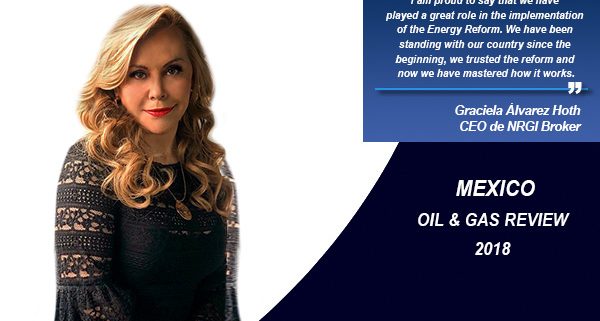
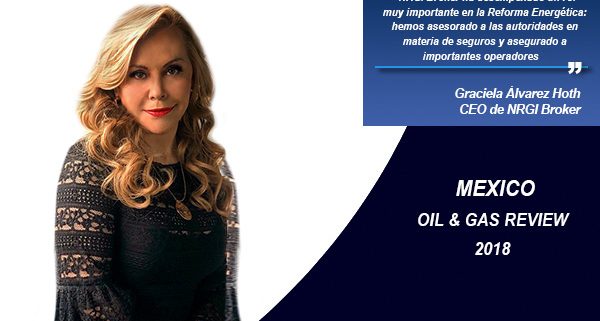
Interview with Graciela Álvarez, CEO of NRGI Broker

Mexico Oil & Gas Review / 18 Julio


Company bio: NRGI Broker specializes in insurance and surety bonds for the Mexican energy sector. It develops custom-made solutions for companies operating in the energy sector, including vessel, construction and engineering and catastrophic risks.


Q: How has NRGI Broker created market opportunities to expand the reach of its services?

A: I am proud to say that we have played a great role in the implementation of the Energy Reform. We have been standing with our country since the beginning, we trusted the reform and now we have mastered how it works. We are a Mexican broker that  has a broad services portfolio and we have consolidated as the best one in the market We have also established “Voces de Energía”, a forum where experts discuss the reform’s environmental, social and fiscal regulations.

Q: How will NRGI Broker benefit its potential clients and partners going forward?

A: In the long term, we see the company as a consolidated reference in the fields of insurance and sureties for the oil and gas industry. We are savvy about the needs of the companies along the entire value chain in hydrocarbons and we are an established adviser for risk management and on financial regulations. We started strong in offshore, ever since activity began in that area, and now we are talking about moving into onshore. The trend is to set new partnerships for storage, pipelines, clean energies and alike. We are investing in putting our brand’s name out there and showcasing that we offer a full range of services few other companies offer.

Q: What are the Top 3 successes of the Energy Reform?

A: I have a vivid memory of observing the Energy Reform’s application when I was acting as an adviser for ASEA in 2014, which gave me the chance to understand how the reform was set in motion. The first success was the implementation itself, which was accomplished according to the same spectrum of norms, rules and opportunities. The second success was the establishment of strong and transparent organisms to guide the implementation that facilitated the cohabitation of all different players in a single environment, which has grown to represent 18 operators. The third is the 72 percent rate of successful allocation of everything that has been tendered in the licensing rounds, demonstrating the genuine interest that local and foreign companies have in Mexico.

Q: How have local and foreign companies adapted to the new regulations and what have been the major hurdles in this process?

A: Everything comes down to an understanding that we need a unified regulatory framework and this cannot be implemented without looking at international standards. The reform’s planning was based on the experiences of seven countries that underwent similar processes, so it is molded to global requirements. Those international players that recently entered the market are used to these types of regulations since they apply to other territories, while many Mexican companies have previously worked with foreign partners that use those standards. For most local companies, application was not an issue. On the contrary, companies operating in the hydrocarbons sector now have the certainty of working in an environment protected by a well-established regulatory framework.

Q: How has NRGI Broker contributed to changing the local mindset and raising awareness about the need for insurance?

A: We advised ASEA when it conducted a three-year study on the best practices and experiences of Australia, Brazil, Canada, Colombia, Norway, the UK and the US that could be applied to the Mexican case. We worked with it every step of the way to establish these rules, from offshore platforms to setting up gas stations, and we developed the administrative dispositions for insurance in the upstream, midstream and downstream sectors. Insurance is required if this industry is to function properly and this mandatory status made things easier for us in terms of application. We are certain about the need to transform the attitude toward insurance and to combine that with our experience, specialization and innovation to offer personalized solutions to our clients.

Q: How will PEMEX’s migration projects make the company more competitive and productive?

A: This is a great strategy for PEMEX to establish investment partnerships that are specialists in how fields work, the reserves included in those fields and the different options to exploit them. This is a long-term investment business that opens the door to new opportunities to turn PEMEX into a more competitive entity. It is a win-win situation. It is important to note that PEMEX gets to keep the land ownership for these migrations; they only allow investment from third parties. One of the company’s future strengths lies in its capitalization and the establishment of partnerships with technology-driven companies. By binding all the parties involved in these type of projects, the companies are forced to bring their A game and deliver on their promises because they would harm themselves if they fell short due to the interdependence ingrained in this framework.

Q: What direction would you like the next administration to follow related to the industry?

A: I hope the next administration understands the implication of keeping the Energy Reform afloat. The reform was meant to contribute to the country and it has been set in motion successfully. The next president should push for new partnerships to continue deepening the reform’s outreach. What is important to understand is that reversing this process would be harmful to the country and it would hurt many companies that have supported and invested in its application.


Para leer la edición 2018, da clic aquí.


Mexico Oil & Gas Review / 18 Julio
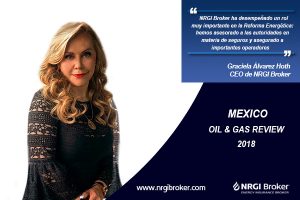


Interview with Graciela Álvarez, CEO of NRGI Broker

Mexico Oil & Gas Review / July 18


Company bio: NRGI Broker specializes in insurance and surety bonds for the Mexican energy sector. It develops custom-made solutions for companies operating in the energy sector, including vessel, construction and engineering and catastrophic risks.


Q: How has NRGI Broker created market opportunities to expand the reach of its services?

A: I am proud to say that we have played a great role in the implementation of the Energy Reform. We have been standing with our country since the beginning, we trusted the reform and now we have mastered how it works. We are a Mexican broker that  has a broad services portfolio and we have consolidated as the best one in the market We have also established “Voces de Energía”, a forum where experts discuss the reform’s environmental, social and fiscal regulations.

Q: How will NRGI Broker benefit its potential clients and partners going forward?

A: In the long term, we see the company as a consolidated reference in the fields of insurance and sureties for the oil and gas industry. We are savvy about the needs of the companies along the entire value chain in hydrocarbons and we are an established adviser for risk management and on financial regulations. We started strong in offshore, ever since activity began in that area, and now we are talking about moving into onshore. The trend is to set new partnerships for storage, pipelines, clean energies and alike. We are investing in putting our brand’s name out there and showcasing that we offer a full range of services few other companies offer.

Q: What are the Top 3 successes of the Energy Reform?

A: I have a vivid memory of observing the Energy Reform’s application when I was acting as an adviser for ASEA in 2014, which gave me the chance to understand how the reform was set in motion. The first success was the implementation itself, which was accomplished according to the same spectrum of norms, rules and opportunities. The second success was the establishment of strong and transparent organisms to guide the implementation that facilitated the cohabitation of all different players in a single environment, which has grown to represent 18 operators. The third is the 72 percent rate of successful allocation of everything that has been tendered in the licensing rounds, demonstrating the genuine interest that local and foreign companies have in Mexico.

Q: How have local and foreign companies adapted to the new regulations and what have been the major hurdles in this process?

A: Everything comes down to an understanding that we need a unified regulatory framework and this cannot be implemented without looking at international standards. The reform’s planning was based on the experiences of seven countries that underwent similar processes, so it is molded to global requirements. Those international players that recently entered the market are used to these types of regulations since they apply to other territories, while many Mexican companies have previously worked with foreign partners that use those standards. For most local companies, application was not an issue. On the contrary, companies operating in the hydrocarbons sector now have the certainty of working in an environment protected by a well-established regulatory framework.

Q: How has NRGI Broker contributed to changing the local mindset and raising awareness about the need for insurance?

A: We advised ASEA when it conducted a three-year study on the best practices and experiences of Australia, Brazil, Canada, Colombia, Norway, the UK and the US that could be applied to the Mexican case. We worked with it every step of the way to establish these rules, from offshore platforms to setting up gas stations, and we developed the administrative dispositions for insurance in the upstream, midstream and downstream sectors. Insurance is required if this industry is to function properly and this mandatory status made things easier for us in terms of application. We are certain about the need to transform the attitude toward insurance and to combine that with our experience, specialization and innovation to offer personalized solutions to our clients.

Q: How will PEMEX’s migration projects make the company more competitive and productive?

A: This is a great strategy for PEMEX to establish investment partnerships that are specialists in how fields work, the reserves included in those fields and the different options to exploit them. This is a long-term investment business that opens the door to new opportunities to turn PEMEX into a more competitive entity. It is a win-win situation. It is important to note that PEMEX gets to keep the land ownership for these migrations; they only allow investment from third parties. One of the company’s future strengths lies in its capitalization and the establishment of partnerships with technology-driven companies. By binding all the parties involved in these type of projects, the companies are forced to bring their A game and deliver on their promises because they would harm themselves if they fell short due to the interdependence ingrained in this framework.

Q: What direction would you like the next administration to follow related to the industry?

A: I hope the next administration understands the implication of keeping the Energy Reform afloat. The reform was meant to contribute to the country and it has been set in motion successfully. The next president should push for new partnerships to continue deepening the reform’s outreach. What is important to understand is that reversing this process would be harmful to the country and it would hurt many companies that have supported and invested in its application.


To read the 2018 edition click here.


Mexico Oil & Gas Review / July 18


¿Cómo debe ser el nuevo CEO de Pemex?

El Financiero / Daniela Loredo / 16 julio


Los expertos consideran que además de provenir de la iniciativa privada, el nuevo líder de la petrolera deberá contar con experiencia para tomar decisiones.

Aunque son tres nombres los que ‘suenan’ para sustituir a Carlos Treviño, actual director de Pemex, en el próximo gobierno de Andrés Manuel López Obrador, expertos definieron el perfil que debe cumplir el nuevo capitán de la petrolera nacional.

Para Arturo García, socio de Energía y Recursos Naturales de Deloitte, el próximo dirigente de la empresa productiva del Estado “debe ser extraído de la iniciativa privada ya sea mexicana o extranjera, además de tener la experiencia que Pemex requiere”, apuntó en entrevista.

De manera extraoficial quienes suenan para ocupar el cargo son Fluvio Ruiz Alarcón, exconsejero independiente de Pemex; Mario Delgado Carrillo, senador y economista colimense; y Octavio Romero Oropeza, Oficial Mayor de Andrés Manuel López Obrador durante su gestión como jefe de gobierno de la Ciudad de México.

En ese sentido, Arturo Carranza, asesor en energía del Instituto Nacional de la Administración Pública, señaló que de ser elegido, Romero Oropeza, a quien se ha señalado como el de mayor predilección para ocupar el cargo, le permitiría tomar decisiones que sacudan a la empresa y que permitan fortalecerla.

“Se requiere un director que tenga toda la confianza del presidente y por ese lado el perfil de Oropeza embona perfectamente a la par que tiene conocimientos financieros”, señaló.

Luis Miguel Labardini, analista de Marcos y Asociados, señaló que desafortunadamente los nombramientos hasta ahora han sido de carácter político. 

El Financiero / Daniela Loredo / 16 julio

Amlo and the realities of Mexico’s oil reform

Petroleum Economist / Craig Guthrie / July 9


The Mexican president-elect needs a strong oil and gas sector to fund a promised social transformation

The investor-friendly tone Mexican president-elect Andres Manuel Lopez Obrador, widely known as Amlo, struck in the run-up to his landslide victory on 1 July is fueling confidence he will tweak rather than dismantle the energy reforms that are enticing international oil companies to the country.

Prospects of an Amlo presidency had stirred concerns among investors for months ahead of the vote—he’s the first leftist Mexican president since the 1930s, and has forged an anti-elitist platform calling for a reordering of the political landscape. And yet the peso gained more than 2% against the US dollar in the hours after the result.

«This can be a presidency ruled by reason and legality,» Ixchel Castro, manager of Latin American oils and refining markets research with Wood Mackenzie, tells Petroleum Economist, while pointing to the currency market’s reaction and the links he’s built with Mexican business elites. «There may be change in the emphasis of the energy reforms, but we see a reversal as highly unlikely».

Launched by outgoing President Enrique Peña Nieto in 2013, the reforms ended Pemex’s 75-year monopoly over the energy sector. So far, auctions in January and March jointly lured at least $100bn in oil exploration investment commitments from more than 70 different firms—useful revenue for a president who has promised sweeping social changes to tackle crime, corruption and poverty.

Amlo made opposition to the reforms a bedrock of his failed 2013 presidential bid, and told a rally just four months ago that he would never allow Mexican crude to return to the hands of foreigners. But a reversal in tack since has seen his top business adviser and nominee for chief of staff, Alfonso Romo, lead a pro-business public relations drive towards international investors.

Romo told Reuters on 25 June that there could be more auctions of oil drilling rights, as long as a review of contracts that have already been awarded to private companies showed no problems. «We will revise them and everything good will remain,» he said, noting that Amlo had said this directly to investors in New York.

But it’s not expected to be all smooth sailing for foreign oil investment under Amlo’s watch. Uncertainty over the long-term goals of his populist agenda will likely continue to unnerve companies looking to establish a steady pipeline of projects.

«Amlo will likely enjoy the benefits from the existing contracts that have been awarded, especially in terms of oil barrels produced, fiscal revenue received and jobs created. By the third year of his administration he can claim that Mexico is producing more oil under his presidency,» Duncan Wood, director of the Mexico Institute at the Woodrow Wilson International Centre wrote in an e-mail.

«But he will be reluctant to continue the bidding rounds. The one possible exception that I see would be in deep waters and in farm-outs from Pemex.»

Mexico plans to auction 37 onshore areas and nine in the shale gas-rich Burgos Basin on 27 September, as well as the farm-out of seven onshore areas with Pemex on 31 October.

Amlo’s approach to a planned re-shaping of Pemex is seen as the next critical indicator of his eventual intentions on the country’s energy direction.

While the president has pledged to resurrect Pemex into a strong national oil company through cost-cutting, this comes amid a significant decline in domestic energy production—from 3.4m barrels of oil a day in 2004 to 1.9m b/d in 2018.

«Pemex must be forced to compete in order to become stronger,» said Wood. «If the reform process is stopped, Pemex would gain from a strengthening of its position in the short-term. But in the long term its competitiveness and productivity could be severely damaged.»


Petroleum Economist / Craig Guthrie / July 9


Mexico Likely To Keep Making The World’s Biggest Oil Hedge

Baystreet Staff / Tsvetana Paraskova / Oilprice / July 9


The Mexican oil hedge, or the Hacienda Hedge, is considered the biggest hedging bet on Wall Street as well as perhaps the most secretive. It has earned Mexico—and a few large investment banks—billions of U.S. dollars.

Mexico buys put options from investment banks and typically hedges a whopping 200-300 million barrels of oil a year. With the put options, it has the right, but not the obligation, to sell oil at a previously set price and timing. But will this tradition continue under the newly elected administration?

Throughout his campaign, Mexico’s now president-elect Andres Manuel Lopez Obrador kept the oil industry on edge with comments and promises that he would review the landmark 2013 energy reform of outgoing President Enrique Peña Nieto that ended seven decades of oil monopoly in the country.

But the first signals from Lopez Obrador’s staff and advisors after he won Mexico’s presidential election last weekend are that the new president would not seek to backtrack on the energy reform, which allowed foreign oil firms to win contracts to pump Mexican oil.

Leftist Lopez Obrador and the new government, set to take office on December 1, will also likely continue with Mexico’s annual oil hedging program—considered to be the biggest annual oil hedge deal on Wall Street—an economic advisor to the president-elect told Bloomberg this week.

For 2018, Mexico locked in last year an average export price of US$46 per barrel of crude oil with its oil hedge. According to data by Mexico’s Finance Ministry, the country spent the equivalent of around US$1.25 billion on the oil hedge program for 2018, which was 21 percent higher than the oil hedge in 2016 to lock in prices for 2017. Mexico’s spending on the world’s biggest oil hedge has been at around US$1 billion over the past few years. State-run Petroleos Mexicanos (Pemex) is also hedging part of its production.

According to a member of president-elect Lopez Obrador’s economic team, Mexico’s oil hedge and the Pemex hedge are “working fine” and are likely to be left unchanged.

“The formula by which the government is calculating the price of oil is a very stable formula,” Abel Hibert told Bloomberg. “Using the hedges reduces uncertainty in financial markets,” the economic advisor said, adding, however, that the hedging program was not mentioned when energy policies were discussed at a meeting of the transition team this week.

Reducing uncertainty seems to be the key message from Lopez Obrador’s team after the election, even beyond the hedging program for oil.

Alfonso Romo, who is tipped to be the next president’s chief of staff, says that the new administration doesn’t want to create uncertainty and that there won’t be rescinding of the energy reform.

“What do we want to do? We want to take advantage of all of the enthusiasm we’ve generated to fix everything we can,” Romo told Bloomberg in an interview. “What don’t we want? To create uncertainty. Zero. I’m terrified of that.”

The incoming president’s chief of staff also said that he didn’t see changes to the 2013 reform.

“If anything happens, it would be done without hurting private investment,” Romo told Bloomberg.

With the energy reform of the outgoing president Peña Nieto, Mexico has attracted oil majors of the likes of ExxonMobil, Chevron, Shell, and Eni to its offshore areas, as it seeks to reverse a decline in its oil production.

Mexico needs a lot of money for offshore drilling, and “no one will fight success” if it manages to boost oil production, according to Romo.

The president-elect Lopez Obrador has said that he would have the already awarded contracts scrutinized for irregularities. But neither Romo nor the likely incoming finance minister Carlos Urzua expects the review of the contracts to reveal acts of corruption.

“If it looks good, on we go. It’s a contract we have to respect,” Urzua told Mexican television on Wednesday.

We are still five months away from the new president and government taking office, but the first messages after the election point that Mexico wants to reassure foreign oil investors and seek reconciliation rather than confrontation.


Baystreet Staff / Tsvetana Paraskova / Oilprice / July 9


Mexico’s incoming leftist President could open US-Mexico energy relations

The Daily Caller /Jason Hopkins / July 2


The election of Andrés Manuel López Obrador as Mexico’s next president has investors around the world on edge, waiting to see how the leftist leader will approach the oil and gas industry.

López Obrador handily won Mexico’s presidential election Sunday, capturing over 53 percent of the vote — more than double the percentage of the second-place finisher. His victory brings a new era of progressive populism to the U.S.’ southern neighbor. A member of the National Regeneration Movement Party, López Obrador touts a far-left pedigree: universal access to public colleges, an expansion of welfare programs, increased investment in industries and other big government proposals.

The president-elect’s calls for energy reform, however, has been the most striking to international observers. López Obrador pledged during the campaign to hold a referendum on reforms the country made several years ago that embraced measured degrees of privatization of the country’s oil sector.

Outgoing President Peña Nieto opened the country’s petroleum industry in 2013 to foreign investment, ending a decades-old monopoly held by Pemex, the country’s state-run petroleum company. The move was intended to revive Mexico’s oil and gas production, which is plagued with rampant inefficiency, debt and outdated equipment.

During the 2018 campaign, López Obrador derided these pro-market reforms. While promising to honor existing oil contracts, he believes the country should prioritize nationalization of the industry once again.

“As a long-time ally of national labor unions and a supporter of a strong [Pemex], [López Obrador] may seek to maximize national investment and employment in the sector, hedging Mexico’s political risk, even at the cost of economic efficiency,” David Goldwyn, chairman of the Atlantic’s Global Energy Center Advisory Group, noted Sunday.

Such reforms could have major implications for Mexico-U.S. energy relations, which hold very deep ties.

The U.S. currently exports a large amount of gas across the border and the Mexican government, in turn, sends heavy crude to American consumers. As crude oil imports to the U.S. has declined over the years, the trade imbalance between the two countries has shifted. U.S. energy exports to Mexico now exceeds its imports, according to the Energy Information Administration. These issues may come up as the Trump administration is set to renegotiate key agreements within the North American Trade Agreement with Mexico and Canada.

López Obrador, for his part, is no fan of Trump. The longtime Mexican politician wrote a book entitled “Oye, Trump” (“Listen, Trump”) that blasts the American leader for his calls to build a border wall and his “attempts to persecute migrant workers.” The book includes a number of speeches López Obrador has given. In one such speech, he compared Trump to Hiter, saying “Trump and his advisers speak of the Mexicans the way Hitler and the Nazis referred to the Jews, just before undertaking the infamous persecution and the abominable extermination.”


The Daily Caller /Jason Hopkins / July 2


Competitive fuel market is still some years off, analysts say

Mexico News Daily / Mileno / June 25


Time, more investment required before gas prices will drop

It will take another two to five years to attain a truly competitive fuel market with lower gasoline prices for motorists, according to industry specialists.

The federal government’s 2013 energy reform opened up Mexico’s retail fuel market to foreign and private companies and there are now more than 2,000 gas stations that operate under a brand other than the state-owned Pemex.

But the increased competition hasn’t translated into cheaper fuel prices as had been expected.

“It was thought that it would be faster but that’s not the case,” said Rodrigo Favela, a consultant and fuel market analyst.

Favela told the newspaper Milenio that based on experiences in other countries, creating a competitive market takes time.

In addition, greater competition in the retail fuel market is not enough on its own to generate lower fuel prices, according to Mexico’s central bank.

In its regional economies report for the last quarter of 2017, the Bank of México said greater investment is needed in the entire gasoline supply chain from the refinery to the gas station in order for prices to drop.

Sebastián Figueroa, CEO of energy operator FullGas, told Milenio that gas stations in the north of the country could start competing on price within one to two years.

He cited proximity to the United States, the presence of existing pipelines, greater ease with which fuel can be imported and lower logistics costs as factors that will likely see fuel prices drop more quickly there than in other parts of the country.

In central states, Figueroa predicted that it would be another three to four years before competitiveness among gas stations increases due to the need for more infrastructure while in the southeast of Mexico, it could take up to five years or more.

In the latter region, the development of the new infrastructure that is needed — such as pipelines —is more complicated because of geological factors, he said.

Considering that fuel prices have actually risen since Mexico’s previously monopolized fuel market opened up, Milenio asked the president of the Senate’s energy committee whether energy reform should be considered a failure.

Salvador Vega Casillas, of the opposition National Action Party (PAN), rejected that suggestion but said it was a mistake to liberalize fuel prices at a time when the value of the US dollar was high against the peso. Gasoline prices were fully deregulated by November 30 last year.

However, Figueroa said that if the government had waited any longer to free prices, more problems could have been created for the sector because a subsidized model is not sustainable.

He maintained that the reform is a positive for Mexico, charging that having only one participant in the downstream sector led to inefficiency whereas competition forces gas stations to offer better deals to motorists.

Federal Energy Secretary Pedro Joaquín Coldwell has also contended that an open and competitive market is the best way to achieve gasoline prices that are accessible to all Mexicans.

Favela explained that there are three main factors that determine the price of petroleum at the pump: international crude oil prices, the prevailing exchange rate and logistics costs.

In order to generate a more competitive market, he argued, all petroleum companies should have non-discriminatory access to the nation’s oil terminals and ports.

Despite opening up the domestic fuel market to new players, the majority of Mexico’s petroleum infrastructure is still controlled by the state oil company Pemex.

The average price of regular — or Magna — gasoline has risen 17% this year, according to the consultancy PETROIntelligence, from 16.24 pesos per liter at the beginning of January to 19 pesos. Prices were as high as 19.11 pesos on Friday in Guadalajara.


Mexico News Daily / Mileno / June 25


El sector energético de cara al entorno electoral

Forbes / Osmar H. Zavaleta Vázquez / 18 Junio


El candidato que resulte electo como presidente tendrá que poner en su justa dimensión el alcance que la reforma energética significa para el crecimiento económico y la competitividad del país.

La reforma energética tiene como antecedente, entre otras cosas, la disminución en la producción diaria de petróleo en México, al pasar de 3.4 millones de barriles producidos al día, en 2004, a 2.5 millones de barriles en 2013. De hecho, a finales de 2017 la producción fue menor a los 2 millones de barriles al día.  Por otro lado, en la actualidad cerca del 60% de la gasolina que se consume en México y poco más del 60% del gas que se utiliza en el país, son importados. Sin duda, esto representa un riesgo de seguridad energética muy importante para México.

Ante esta realidad, sabemos que el gas natural y el petróleo del futuro provendrán de las llamadas “fuentes no convencionales”, que se encuentran en cuencas de lutitas y en aguas profundas. Aunque México cuenta con grandes reservas de estos recursos, carece de la capacidad tecnológica, financiera y de ejecución para extraer estos hidrocarburos de forma competitiva.

En virtud de lo anterior, la reforma energética abrió la posibilidad de que inversionistas privados participen tanto en el sector eléctrico como en el sector de hidrocarburos. En este último, se diseñaron las rondas, con diferentes fases de licitación, para que inversionistas privados, en diferentes esquemas, destinen sus recursos financieros, tecnológicos y humanos para explorar y extraer petróleo en aguas profundas y someras, principalmente, a través de diferentes esquemas contractuales. Incluso Pemex, que tuvo todas sus adjudicaciones en la Ronda Cero, ha establecido contratos de asociación con entidades privadas a través del esquema de Farm Out, con la intención de compartir el riesgo, en proyectos complejos, a cambio de compartir los beneficios derivados de la extracción, por supuesto. Los esquemas definidos a partir de la Ronda 1 están trayendo y traerán beneficios significativos para México sin que nuestro país corra ningún tipo de riesgo.

De acuerdo con la Sener, se han comprometido cerca de 56 mil millones de dólares para exploración y extracción de petróleo y cerca de 12 mil millones de dólares en gasoductos, además de los casi 7 mil millones de dólares para generar energías limpias, sin contar todas las subastas para el suministro de energía a CFE.

En el sector eléctrico se abrió la posibilidad de que inversionistas privados participen en la generación, comercialización y suministro de energía eléctrica lo que inducirá parte de la competitividad que el país requiere en su actividad industrial. También se abrió la posibilidad de invertir en la modernización de la infraestructura que se requerirá para la transmisión y distribución de energía eléctrica.

El renovado sector energético de México busca:

a) La apropiada participación de México en un contexto económico global.

b) Reducir el costo de los energéticos.

c) Alcanzar los niveles de desarrollo social, económico y de cuidado ambiental que el país requiere.

d) Propiciar la competitividad que el país requiere.

Es claro que todo esto apenas comienza y, sin duda, muchos de los frutos de lo que hasta ahora se ha sembrado se verán en el mediano plazo, por lo que el siguiente presidente de México debe tener claridad de lo que representa el avance que, en materia energética, el país ha logrado.

En virtud de la relevancia que el sector energético tiene para México, el presidente que resulte electo el 1 de julio debe cuidar la competitividad del país, propiciar mayor bienestar a las familias mexicanas y cumplir con los compromisos, en materia de sustentabilidad, que nuestro país ha asumido a través de la reforma energética.

En este sentido, es común que nos preguntemos, ¿cuáles son los posibles escenarios para el sector energético ante los posibles resultados electorales que tendremos el primer día de julio? Sobra decir que Ricardo Anaya, José Antonio Meade y, en menor medida, Jaime Rodríguez se han pronunciado a favor de darle continuidad a esta reforma constitucional por lo que, en caso de que cualquiera de ellos tres gane la elección presidencial, considero que todas las iniciativas del sector energético, que se han detonado hasta el día de hoy, continuarán sin cambios significativos y con un creciente impulso.

Si Andrés Manuel López Obrador gana la elección presidencial creo, en términos de diferentes declaraciones y pronunciamientos que él y los miembros de su coalición han hecho, que el dinamismo del sector disminuiría. Coincido con el candidato en que sería necesario revisar la legalidad de los contratos asignados, pero no coincidiría en derogar la reforma energética, en virtud de lo que el sector energético representa para la competitividad del sector productivo de nuestro país.

Al margen de filias y fobias, el candidato que resulte electo como presidente de México tendrá que poner en su justa dimensión el alcance que la Reforma Energética de México significa para el crecimiento económico y la competitividad del país.


Forbes / Osmar H. Zavaleta Vázquez / 18 Junio


Risk And Reform: Observing Effective Controls In Mexico’s Rapidly Transforming Energy Sector

Forbes / Armando Ortega / 11 Junio


MEXICO CITY—For decades, the most relevant compliance legislation for international companies operating in Mexico was the US Foreign Corrupt Practices Act. Now, as a result of major national economic and legal reforms enacted during President Peña Nieto’s administration from 2012-2018, Mexico’s compliance environment has undergone a transformation. As foreign investment pours into Mexico’s recently opened oil and gas sector, legal entities are now criminally liable for any offenses or irregularities committed in their name, making the case for a robust compliance strategy that includes due diligence investigations into possible business partners.

A changing landscape: Mexico’s Energy Reform

Mexico enacted a historic reform program in December of 2013 that opened its oil and gas sector to foreign investment following 75 years of government ownership. Mexico’s energy reform plan was part of a broader, cross-sector effort by President Enrique Peña Nieto to boost the Mexican economy. Since its implementation, there have been three bidding rounds—the latest of which closed in March 2018—that have raised a total of $161.3 billion for investments that will take place until 2025. Fourteen percent of total investment is for public-private partnership projects between domestic and international companies and the Mexican state-owned oil company, Petróleos Mexicanos (Pemex). With these investments, Pemex expects to significantly increase Mexico’s current production of 2 million barrels per day to a hypothetical 3.4 million barrels per day.

There is significant international interest in the process, with 34 companies securing bids. The US, with nine companies, and the UK, with four, lead the pack. Royal Dutch Shell, Qatar Petroleum, British Petroleum and Chevron are just a few of the major multinationals that have a stake in Mexico as a result of the energy reform.

Although significant opportunities are opening up in the sector, it is key that international investors understand the complexities involved with the energy reforms, as they are occurring amid a rapidly changing regulatory environment and era of overall reform resulting from the Peña Nieto years, and as part of a broader shift in sentiment among the Latin American public in the fight against corruption.

The National Anticorruption System and the new compliance environment

In what can be best understood as a citizens’ effort, a set of new legislative and constitutional reforms have been introduced in Mexico since May 2014, culminating in the establishment of the National Anticorruption System (SNA) in July 2016. The SNA is defined as a coordinating body between various institutions, including the Superior Audit of the Federation and the Federal Court of Administrative Justice, among others, to create mechanisms of collaboration and coordination to effectively prosecute corrupt practices.

The SNA is still in its early stages; a Specialized Prosecutor’s Office in Combating Corruption has yet to be properly established, and the Mexican Congress has yet to elect the Anticorruption Prosecutor. However, despite the lack of distinct progress, parts of the legal reforms introduced to create the SNA already have far-reaching implications.


Forbes / Armando Ortega / 11 Junio


Pemex firma contratos para exploración y extracción de hidrocarburos en aguas profundas del Golfo de México

From: Aristegui Noticias / 8 Mayo


La empresa informó que un contrato fue suscrito con Shell, otro con Chevron e Inpex y dos de manera individual.

Este lunes Petróleos Mexicanos firmó cuatro contratos para la exploración y extracción de hidrocarburos, en aguas profundas del Golfo de México, licitados por la Comisión Nacional de Hidrocarburos en la ronda 2.4.

De acuerdo con un comunicado, un contrato fue firmado con Shell, otro con Chevron e Inpex y dos de manera individual.

En la negociación participaron el director general de Pemex Exploración y Producción,Juan Javier Hinojosa Puebla; el director de Shell en México, Alberto de la Fuente; la directora de Chevron México, Evelyn Vilchez, y el director general de Inpex México, Ryo Manabe.

Pemex destacó que “los cuatro nuevos contratos permitirán explorar de manera conjunta en aguas profundas, donde la empresa productiva del Estado ha demostrado capacidades técnicas y operativas, ahora compartiendo riesgos tecnológicos y financieros”.

En los bloques 5 y 18, que se localizan en las provincias geológicas Cinturón Plegado Perdido y Cordilleras Mexicanas, Pemex es el operador con 100 por ciento de participación.

En el bloque 2, que se ubica en la provincia geológica de Perdido del Golfo de México, Pemex participa conjuntamente con Shell, con una participación de 50 por ciento, siendo la compañía angloholandesa el operador del consorcio.

En relación al bloque 22, que se encuentra en la provincia geológica Cuenca Salina, la empresa productiva del Estado participa con un porcentaje de 27.5 por ciento junto con la estadounidense Chevron y la japonesa Inpex. Los estudios preliminares del bloque sugieren que el hidrocarburo esperado corresponde a crudo pesado.


From: Aristegui Noticias / 8 Mayo