Listado de la etiqueta: NAFTA

RBC boss says chances of NAFTA being scrapped are rising

FROM: Thomson Reuters / 9 de Enero de 2018

TORONTO — Royal Bank of Canada’s Chief Executive Dave McKay said on Tuesday he believes there is now a greater chance that the North American Free Trade Agreement could be scrapped.

“I think the probabilities are increasing that you’ll have some type of dynamic where there is an announcement of a scrapping of NAFTA,” he said at a Canadian Bank CEO conference hosted by RBC in Toronto.

Canadian bankers have expressed concern about the progress of talks to rework the trade agreement and how renegotiations could hamper the ability of clients to do business with customers in the United States and Mexico.

McKay said he agreed with other business leaders and the Canadian government that no deal would be better than a bad deal.

“We don’t want to be stuck long-term with a deal that hurts our economy,” he said.

McKay also said RBC, Canada’s biggest bank by market value, is now spending $3 billion a year developing new technologies. The bank is one of the biggest Canadian investors in technology such as artificial intelligence and blockchain and has increased the proportion of its technology spending on innovation compared with maintaining existing systems.

© Thomson Reuters 2018

royal mc

FROM: Thomson Reuters / 9 de Enero de 2018

Mexico to Discuss Security With U.S. in Parallel to Nafta

From: Bloomberg / Eric Martin / 11 de Diciembre de 2017


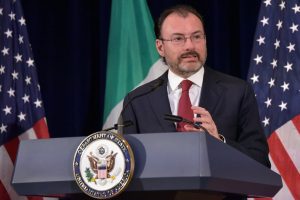
Mexico’s top diplomatic and interior officials will visit Washington this week to discuss security cooperation with their U.S. counterparts at the same time that negotiators work to overhaul Nafta, according to four people familiar with the plans.


The visit by Mexican Foreign Relations Minister Luis Videgaray and Interior Minister Miguel Angel Osorio Chong to meet with Secretary of State Rex Tillerson and Homeland Security Secretary Kirstjen Nielsen on Thursday is a follow-up to meetings in May, according to the people, who asked not to be named before the agenda is made public. It’s aimed at coming up with strategies to combat transnational criminal organizations, the people said. The press office of the Mexican Foreign Ministry and the U.S. State Department declined to immediately comment.


The meetings coincide with a sitdown by negotiators from the U.S., Mexico and Canada to update the North American Free Trade Agreement at the demand of U.S. President Donald Trump, who says the deal is responsible for hundreds of thousands of lost manufacturing jobs in the U.S. In an interview last month, Videgaray said that if the Nafta renegotiation encounters trouble, it could impact other areas of cooperation with the U.S. such as security and immigration. Mexico this year has seen homicides surge to the highest levels of this century, surpassing the previous record levels of the drug war from 2010 to 2012.

“It’s good for Mexico that we cooperate with the U.S. on security and also on migration and many other issues,” Videgaray said in the interview in Vietnam on Nov. 11. “But it’s a fact of life and there is a political reality that a bad outcome on Nafta will have some impact on that,” he said. “We don’t want that to happen, and we’re working hard to get to a good outcome.”

Videgaray told reporters last month that Mexico is prepared for the end of Nafta if it can’t reach a deal with the U.S. and Canada that benefits the nation. The three countries in August began talks to rework the pact after Trump pledged during the 2016 campaign to overhaul or end it.

This Week’s Talks

The latest meetings to revamp Nafta, taking place at the Mayflower Hotel, will run through Friday, largely out of the spotlight. Cabinet-level officials aren’t scheduled to attend for the second time since negotiations began, and the Trump administration is preoccupied with efforts to push through tax cuts by year-end and avoid a government shutdown. Videgaray’s portfolio includes the broad bilateral relationship with the U.S., while a team led by Economy Minister Ildefonso Guajardo has been focused on the commercial details of the Nafta negotiation.
videgaray


From: Bloomberg / Eric Martin / 11 de Diciembre de 2017
German firms more upbeat on Mexico, wary on NAFTA collapse – survey

From Euronews / Dave Graham, Andrew Hay / 5 de Diciembre de 2017

German companies are more upbeat about the business outlook in Mexico than they were a year ago, but more than two-thirds believe that an end to the NAFTA trade deal would hurt their business there, a survey showed on Tuesday. The poll by the German-Mexican chamber of industry and commerce (CAMEXA) showed that more companies planned to invest and increase staffing than they did when surveyed a year ago, shortly after U.S. President Donald Trump’s election victory.

Some 54.6 percent of firms said they would boost staffing levels in 2018, a rise of nearly 10 percentage points from a year earlier. Almost 68 percent said they planned investment in the coming year, an increase of some 6 percentage points. The survey, which was carried out at the end of November, showed that 69 percent of firms believed that a collapse in the North American Free Trade Agreement (NAFTA) would have a negative impact on their business in Mexico. A total of 130 companies took part, CAMEXA said. Trump has repeatedly threatened to withdraw from NAFTA if he cannot rework it to the advantage of the United States. Negotiations between the United States, Mexico and Canada to rework NAFTA have made only halting progress so far, and many major points of disagreement remain with the Trump administration seeking to promote his America First agenda. The three nations have vowed to continue talks to overhaul the almost 24-year-old trade deal through March, when the Mexican 2018 presidential campaign begins in earnest.

german

From Euronews / Dave Graham, Andrew Hay / 5 de Diciembre de 2017

Mexican Peso’s Top Analyst Says Worst Is Over Even If Nafta Dies

«Mexico’s peso won’t return to the record lows it reached this year even if the U.S. makes good on threats to undo the trade agreement that transformed Latin America’s second-largest economy into an export powerhouse, according to the currency’s top forecaster.

The selloff that sent the peso plunging to 22 per dollar in the days before Donald Trump’s inauguration was overdone despite the threat to Nafta, said Scott Petruska, a foreign-exchange adviser for Silicon Valley Bank who was the most accurate analyst in the first quarter according to Bloomberg rankings. He correctly predicted that the currency would recover from the rout to become one of the best performers in the world this year.

«The Trump administration seems to have Mexico in its cross hairs which makes everybody very nervous, whether it’s negotiating Nafta or slapping some sort of tariff or border tax on imports from Mexico,» Petruska, who was also the top forecaster for Canada’s dollar, said from Boston. «But we can appreciate that Mr. Trump’s bark is often times worse than his bite.”

The peso plunged 15 percent from Trump’s surprise election win to when he took office as investors speculated he would damp foreign investment and suppress exports to the U.S., the destination for 75 percent of the goods Mexico sends abroad. It erased some of those losses in the first quarter as the central bank raised interest rates and U.S. officials indicated they probably wouldn’t seek to scrap Nafta entirely. Mexico central bank Governor Agustin Carstens said Wednesday that the peso — at about 18.8 per dollar — is still undervalued.

Petruska sees the peso weakening to 20 per dollar by September as traders overreact to whatever trade negotiations get underway, but says it will quickly recover to trade at 19 by the end of the year. The currency will gain to 18.3 per dollar by the end of 2018, he said.

With a benchmark lending rate of 6.5 percent, Mexico offers a higher return on local bonds than peers such as India, Peru and Chile. Volatility in the peso, meanwhile, has plummeted in the last few months and «speculators will feel comfortable going into the carry trade,» Petruska said.»

by Isabella Cota / Bloomberg

6 de abril de 2017 4:00 GMT-5


17 Octubre_Oil Speculators


Mexico, NAFTA and energy on the same side

When it comes to NAFTA and energy, there is no doubt that Mexico gets the better end of the deal with a series of special carve outs for its national industry. The result has been an unbalanced, incongruous relationship between the United States, Mexico and Canada. In other words, when it comes to energy, NAFTA is anything but free trade .

Take the following examples from chapter six of NAFTA, addressing energy trade:

An American company is permitted to open a power plant in Mexico to generate power for Texas, but, according to the provisions carved out for Mexico’s nationalized energy industry, the power plant would have to sell all of its excess power to Mexico’s Federal Electricity Commission (CFE) at the rate negotiated by CFE. ( Annex 602.3(5) ) If a cogeneration plant is built in Mexico with the express purpose of providing power for a Canadian company’s factory in Mexico, then, according to NAFTA, it must sell any excess power to CFE. ( Annex 602.3(5)(b) ) In both cases, the American and Canadian operations face a disadvantage in price negotiations because they are required to sell excess power to CFE only.

When it comes to oil and gas exploration, NAFTA includes a provision requiring the three countries to maintain incentives to encourage companies to find new energy reserves. ( Article 608.1 ) However, in the special provisions, Mexico is exempted from incentivizing – or even permitting – private exploration and development. This special provision makes clear that “the Mexican State reserves to itself” all E&P, nuclear power, foreign trade, transportation, storage, distribution and electrical supply within its own borders. ( Annex 602.3(1) ). In the U.S. and Canada, free trade in energy exploration must be promoted. In Mexico, the government can do what it chooses .

Mexico is allowed to “restrict the granting of import and export licenses for the sole purpose of reserving foreign trade” in a variety of energy goods including (but not limited to): aviation fuel, gasoline, shale and tar sands, diesel oil, most forms of commercial gasses and kerosene. ( Annex 603.6 ). The U.S. and Canada must keep import and export licenses open.

These carve outs meant to favor Mexico’s national energy industries have not been kind to Mexico’s economy, energy supply or business development. Mexico has insisted one form or another of nationalized energy for almost a century . Basic tenants of capitalism explain that a closed, national energy regime prohibits competition, leading to misalignment of resources and prices. Absent a truly robust and well-managed system in Mexico, this is what happened.

In 2014, historically low levels of oil production, higher energy consumption and depleted oil reserves led Mexico amend its constitution to open Mexico’s state energy industries to foreign investment. These changes permitted the Mexican government to auction off certain oil and gas leases to foreign, private companies for development and to allow foreign companies to participate in owning pipelines, refineries, petrochemical plants and even electricity generation. Mexico also committed to bringing gasoline and natural gas prices in line with market prices rather than setting them artificially.

Although the process has not always been smooth – Mexico is experiencing gasoline shortages and spikes in gasoline prices, in part, as a result of these efforts – the overall trend towards liberalization in Mexico’s energy industry is promising. Many companies have bid for offshore leases to produce oil and gas in the Gulf of Mexico and the opportunities to invest in Mexican energy businesses are growing.

Since the Mexican state is no longer the only legal investor, owner, producer, buyer and seller of energy and energy products in Mexico, there is now a potential to renegotiate chapter six of NAFTA and eliminate the special provisions and carve outs for Mexico. This would not only help improve Mexico’s energy situation, but improve trade relations amongst the three North American trade partners.

Grupo México proyecta invertir en energía

Grupo México proyecta invertir en energía

Story by Ellen R. Wald, Ph.D. is a historian and scholar of the energy industry / Petroleumworld

02 17 2017