Listado de la etiqueta: México

Los retos ambientales en el Sector Energético

Es indiscutible que la dinámica del mundo se basa en gran medida en el consumo de energía, no obstante actualmente nos enfrentamos al reto de desarrollar fuentes de energía que sean sostenibles y sustentables, lo cual implica armonizar el  binomio compuesto por el desarrollo económico y la protección ambiental.

En este contexto, es importante destacar que si bien, en algunas partes del mundo se pueden observar avances importantes para el desarrollo de energías renovables, una fuente muy importante siguen siendo los hidrocarburos[1].

El reto para las naciones que están comprometidas en desarrollar fuentes de energía limpias es mayúsculo. El caso de México es un gran ejemplo, pues se trata de un país que se encuentra en pleno desarrollo de su Reforma Energética, que implica por un lado, el aprovechamiento de recursos energéticos estratégicos como el petróleo (a través de las Rondas de licitaciones), pero por otro lado, se encuentra comprometido con lograr el avance en la generación de energías limpias en un plazo de tiempo determinado, como puede verse en el documento denominado Agenda 2030, signado por nuestro país.

Lo anterior implica actuar en diversos frentes, a fin de lograr consciencia entre los diversos actores que se desempeñan en el sector de la energía,  un sector que además típicamente ha sido considerado como de alto riesgo.

Afortunadamente, entre los ciudadanos existe también una mayor conciencia acerca de la importancia de cuidar los ecosistemas y en este sentido valoran mucho que una empresa genere y utilice responsablemente la energía.

La ley es muy clara cuando señala que “el que contamina paga”, de manera que aquellos que lleguen a causar un daño al medio ambiente, deberán repararlo adecuadamente. Sabemos que los costos de una catástrofe ambiental pueden llegar a ser muy altos, de ahí que aquellos sectores que son considerados de alto riesgo, la regulación establezca la obligación de contratar seguros, que les permitan responder por los daños que puedan causar con sus actividades.

Por lo anterior, uno de los retos ambientales más importantes en el sector energético es reforzar la cultura de aseguramiento, pero tomando en cuenta que los seguros aunque son indispensables, -dado que el riesgo siempre está presente- deben ser el último recurso. Lo más importante es que a las actividades de toda la cadena de valor se incorporen las mejores prácticas internacionales para evitar que sucedan accidentes.

En NRGI Broker, somos expertos en seguros para el Sector Energético. Acércate a nosotros, con gusto te atenderemos.

[1]De acuerdo con el reporte World Energy Resources 2016,emitido por el Consejo Mundial de Energía, Ver: http://www.worldenergy.org/wp-content/uploads/2016/10/World-Energy-Resources_Report_2016.pdf, p. 4.

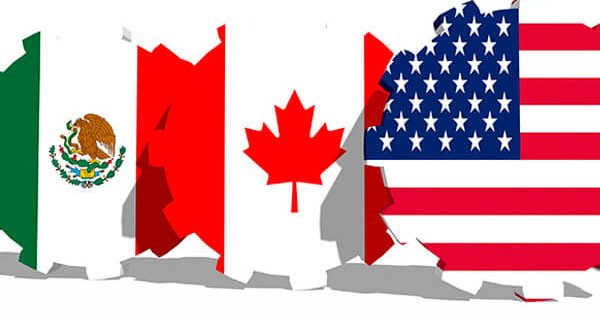
 

NAFTA negotiations enter critical week with the U.S. still pushing a hard line

From: Financial Post / Thomson Reuters / Veronica Gomez and Anthony Esposito / May 7


Sources close to the talks have suggested there is a creeping feeling of uncertainty and pessimism because of gridlock on the most critical issues

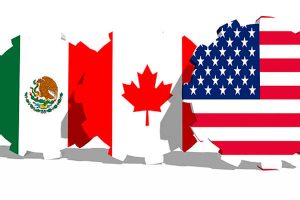
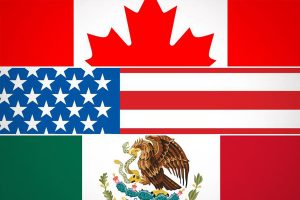
WASHINGTON — Talks to update the NAFTA trade deal enter a make-or-break week on Monday, as ministers from Canada, the United States and Mexico seek to resolve an impasse in key areas before elections in Mexico and the United States complicate the process.

Discussions in Washington will center on rules of origin that govern what percentage of a car needs to be built in the North American Free Trade Agreement region to avoid tariffs, the dispute-resolution mechanism and U.S. demands for a sunset clause that could automatically kill the trade deal after five years.

U.S. Trade Representative Robert Lighthizer warned last week that if the talks took too long, approval by the Republican-controlled Congress may be on “thin ice.” The aim is to complete a vote during the “lame-duck” period before a new Congress is seated after November’s congressional elections.

Mexico holds its presidential election on July 1 and the front-runner, leftist Andres Manuel Lopez Obrador, says he wants a hand in redrafting NAFTA if he wins.

“We have a window of opportunity in the next two or three weeks … considering two things: where the talks are now and the political calendars” in Mexico and the United States, said Moises Kalach, head of the international negotiating arm of Mexico’s CCE business lobby, which is leading the private sector’s involvement in the talks.

Sources close to the talks have suggested there is a creeping feeling of uncertainty and pessimism going into the new round because of gridlock on the most critical issues.

At the heart of the NAFTA revamp is U.S. President Donald Trump’s desire to retool rules for the automotive sector in order to try to bring jobs and investment back north from lower-cost Mexico. Despite months of talks on the issue, the sides remain far apart.

A round of talks among Canadian Foreign Minister Chrystia Freeland, Mexican Economy Minister Ildefonso Guajardo and Lighthizer scheduled for last week was cancelled to allow consultations with the Mexican car industry and for the American to go on a trade mission to China.

Mexico’s main auto sector lobby has described the latest U.S. demands, which include raising the North American content to 75 per cent from the current 62.5 per cent over a period of four years for light vehicles, as “not acceptable.”

“The positive momentum on the rules of origin appears to be counterbalanced by the opposite movement on labour wage treatment proposals,” said Flavio Volpe, president of Canada’s Automotive Parts Manufacturers Association.

The U.S. proposal also would require that 40 per cent of the value of light-duty passenger vehicles and 45 per cent for pickup trucks be built in areas with wages of US$16 per hour or higher.

That is seen as a hard pill to swallow for Mexico, where the Ann Arbor, Michigan-based Center for Automotive Research has estimated auto assembly workers average under US$6 an hour, and auto parts plants workers average less than US$3 an hour.

Critics also say it would create a bureaucratic nightmare of paperwork.


From: Financial Post / Thomson Reuters / Veronica Gomez and Anthony Esposito / May 7


trabajando

La Administración de Riesgos en el Sector Hidrocarburos

Uno de los nuevos órganos reguladores que surgieron con la Reforma Energética fue la Agencia Nacional de Seguridad Industrial y Protección del Medio Ambiente del Sector Hidrocarburos (ASEA), con el objetivo de promover la cultura de la previsión entre los regulados, por ello, el 13 de mayo de 2016, se publicaron en el Diario Oficial de la Federación, las Disposiciones Administrativas de carácter general que establecen los lineamientos para la conformación, implementación y autorización del Sistema de Administración de Seguridad Industrial, Seguridad Operativa y Protección Ambiental (SASISOPA).

El SASISOPA es un conjunto de elementos interrelacionados y documentados cuyo propósito es prevenir, controlar y mitigar una instalación o un conjunto de ellas en materia de seguridad industrial, seguridad operativa y protección ambiental.

Su objetivo primordial es mitigar el riesgo inherente a las instalaciones y actividades del sector hidrocarburos, a fin de evitar accidentes y con ello garantizar la seguridad de las personas, los bienes y el medio ambiente.

Tomando en consideración que las empresas no empiezan de cero en la conformación del sistema de administración, se estableció la obligación de elaborar un Documento Puente, en el que conste el estudio de correspondencia de los elementos del sistema de administración de cada empresa con los establecidos en el artículo 13 de la Ley de la ASEA, para estar en posibilidad de conformar, implementar y obtener la autorización del SASISOPA.

Lo anterior, permite retomar las medidas previas y complementarlas con las políticas establecidas por la ASEA, para lograr la uniformidad en el sector.

Uno de los aspectos más importantes para la conformación del SASISOPA es la identificación de peligros y análisis de riesgos, para definir las medidas de prevención, control y mitigación, así como la valuación de incidentes, accidentes y pérdidas esperadas en los distintos escenarios de riesgo, en función de las consecuencias que esos riesgos representan en la población, medio ambiente, instalaciones y edificaciones comprendidas en el perímetro de las instalaciones industriales y en las inmediaciones.

La identificación de riesgos y la valuación de incidentes y accidentes son componentes fundamentales para tomar medidas preventivas y determinar cuáles serán los mecanismos correctivos en caso de que se llegara a materializar el riesgo.

En este punto, la contratación de los seguros es indispensable, pues una vez identificado y valuado el riesgo, se podrán contratar los seguros adecuados y suficientes para transferir el riesgo y con ello evitar que la empresa pueda ver afectadas sus finanzas por la reparación de los daños ocasionados por un siniestro.

En NRGI Broker, somos expertos en seguros para el Sector Hidrocarburos. Acércate a nosotros, con gusto te atenderemos.


trabajando

trabajando

Mexico Opens Last Round Of Oil Bidding Before Election

From: Oil Price / Oxford Business Group / 28 April 2017


The latest round of open bidding for exploration rights in Mexico’s energy sector received mixed interest, with two further rights sales to take place later in the year.

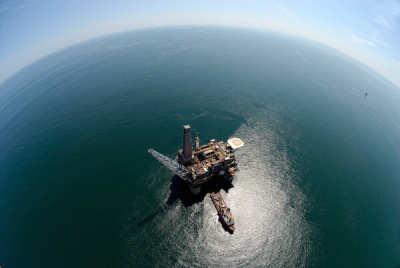
Of the 35 shallow offshore blocks on offer in the March 27 auction, 16 were sold, with the strongest interest seen in blocks in the Sureste Basin – in the south-eastern portion of the Gulf of Mexico – where all eight offerings found buyers.

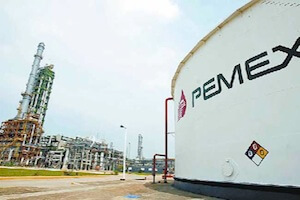
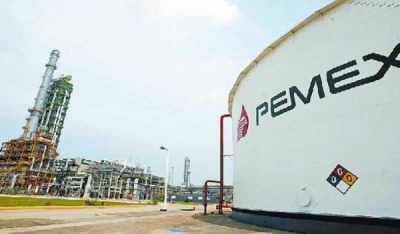
Mexico’s state-owned oil producer, Petróleos Mexicanos (Pemex), won seven of the blocks on offer, one in its own right and six more in partnership with overseas energy firms.

Fourteen oil majors were pre-qualified to bid alongside 22 consortia. France’s Total was the biggest winner in the Sureste Basin, coming away with the largest share of three blocks coverin­­g a total of 2342 sq km. It received two of these as part of a consortium with Pemex, and one with BP and Pan American.

The Ministry of Energy estimates that developing and operating the 16 blocks will require investment of $8.6 billion over the lifetime of the deposits.

Related: How High Can Trump Push Oil Prices?

Overall response to the auctions was slightly muted, with local and international majors showing some caution when making offers, partly due to the upcoming presidential election in July 2018, which has sparked concerns about potential changes to energy sector policy and rising supply in the market.

Auctions for shale deposits set for September

Indeed, the March auction was the first of up to three rights sales to be staged this year, with the remaining two land bids scheduled for late July and early September. The former will cover a total of 37 contractual areas in Burgos, Tampico-Misantla-Veracruz and the Sureste Basin.

The September round of bidding will be particularly notable, as it will be the first time that development rights for shale deposits have been auctioned off in Mexico.

Depleting natural gas reserves and high potential for shale – the country has 545trn cu feet of technically recoverable sources of shale gas, according to the World Resources Institute – have driven Mexico to accelerate development of the industry.

Early last month the energy sector regulator, the National Hydrocarbons Commission (Comisión Nacional de Hidrocarburos, CNH), called for bids on nine blocks in the Burgos Basin – located in the state of Tamaulipas, in the north-west of the country – to be auctioned off in September.

The blocks contain an estimated 1.1 billion barrels of oil equivalent (boe), and winning bidders will have the right to conduct exploratory work for conventional oil and gas, as well as any shale deposits identified.

Energy reform supports private sector development

The successive rounds of auctions for exploration and production rights are the keystone of Mexico’s energy reform policy. Launched in 2013, the reforms ended Pemex’s upstream and downstream monopoly, and offer the country the potential to generate $1trn of foreign direct investment by 2040, according to the Mexican Association of Hydrocarbons Companies.


From: Oil Price / Oxford Business Group / 28 April 2017


Mexican Oil Giant Pemex Seeks Partners to Drill in 7 Southern Areas

FROM: Sputnik News / 27 April 2017


MEXICO CITY (Sputnik) – Mexico’s state oil giant Pemex is looking for partners in joint ventures that will drill at seven onshore areas in the country’s south, the national hydrocarbons authority said Thursday.

Contracts for drilling in the states of Veracruz, Chiapas and Tabasco will be signed for a period of 35 to 40 years with a possibility of a ten-year extension, according to the National Hydrocarbons Commission.

Mexico has been overhauling its energy sector since late 2013. The reform ended almost 80 years of Pemex’s monopoly by allowing foreign investments and contracts with private businesses.


FROM: Sputnik News / 27 April 2017


Mexico fully expects to reach a consensus on NAFTA trade deal

FROM: CNBC / Sam Meredith / 22 April 2018

Mexico believes it is on the brink of agreeing to the modernization of the North American Free Trade Agreement (NAFTA).

Alongside the U.S. and Canada, Mexico is in the midst of eight-month-old talks to try to update the NAFTA deal — which is thought to underpin about $1.2 trillion in yearly trilateral trade.

«In the baseline scenario of the central bank, we have that there will be a version of NAFTA,» Mexican Central Bank Governor Alejandro Diaz de Leon told CNBC’s Joumanna Bercetche on Saturday.

«We know that there have been ups and downs in the negotiation … (But) we do hope that the advantages for the three countries will prevail in some version of the agreement,» he added.

Rules of origin

In an apparent bid to try to quickly wrap up the reworking of the 24-year-old accord, leading Mexican officials have sought to convey an upbeat tone in recent days.

Late last week, Mexico’s Economy Minister, Ildefonso Guajardo, said lawmakers had made «a lot of progress» after the second day of meetings with U.S. Trade Representative Robert Lighthizer and Canada’s Chrystia Freeland. And on Sunday, Mexican President Enrique Pena Nieto said his country was feeling optimistic about the prospect of being able to successfully conclude the talks in the coming weeks.

Canada’s Foreign Minister Chrystia Freeland (C) speaks before the start of a trilateral meeting with Mexico’s Economy Minister Ildefonso Guajardo (L) and U.S. Trade Representative Robert Lighthizer during the third round of NAFTA talks involving the United States, Mexico and Canada in Ottawa, Ontario, Canada, September 27, 2017.

Ministers from the U.S., Canada and Mexico are trying to press ahead with the negotiations in order to try to avoid clashing with a presidential election in Mexico on July 1. Nonetheless, reaching this milestone would mean overcoming major differences on several U.S. demands.

Canada and Mexico have battled with the U.S. over their apparent reluctance to adhere to tougher NAFTA regulations on the content of vehicles made in North American nations. Often referred to as the rules of origin, it is widely considered to be a key sticking point to the talks.

President Donald Trump’s negotiators had initially called for tariffs on the content of vehicles made in NAFTA nations to increase to 85 percent from 62.5 percent. However, Washington’s stance over this issue has reportedly softened in an effort to reach a consensus with their North American neighbors sooner rather than later.

Market has ‘priced in’ NAFTA outcome

The U.S. was thought to be looking to secure a deal in principle with the NAFTA agreement sometime over the next three weeks. Meanwhile, Mexico’s Guajardo said he saw an 80 percent chance of reaching a deal by the first week of May.

Trump, who has repeatedly threatened to walk away from the negotiating table in the absence of major changes, has criticized the pact for creating jobs in Mexico at the expense of U.S. workers.

When asked to what extent it had been a challenge to manage Mexico’s currency at a time when tweets from the U.S. president could prompt volatile swings in the exchange rate, Mexico’s Diaz de Leon replied: «Obviously some of these news and posture and messages have an effect on the exchange rate, but I also think the exchange rate has been learning how to extract the signal from those pieces of information.»

«So far, the market has priced in the NAFTA event according to what is likely to happen,» he added.

FROM: CNBC / Sam Meredith / 22 April 2018


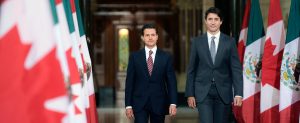
Trudeau meets with Mexican president at critical time in NAFTA talks

From: Lee Berthiaume / The Canadian Press / Times Colonist / 13 April


LIMA, Peru — Two of the three political leaders with the most at stake at the NAFTA table huddled Friday behind closed doors, their most senior trade lieutenants alongside, in hopes of unlocking a mutually beneficial solution to the cross-border conundrum posed by U.S. President Donald Trump.

Prime Minister Justin Trudeau and Mexican President Enrique Pena Nieto gathered on the sidelines of a major international summit in Peru’s capital, along with Foreign Affairs Minister Chrystia Freeland and Mexico’s economy secretary Ildefonso Guajardo.

 U.S. Trade Representative Robert Lighthizer pulled out of the summit at the last minute, sending his deputy, C. J. Mahoney, in his place.

The sit-down, the first face-to-face between the two leaders since November, comes at a critical time, with Canada, Mexico and the U.S. all looking for a breakthrough in the ongoing effort to update the North American Free Trade Agreement — and Trump’s wild-card trade strategies doing little to clear the air.

It was also a chance for Trudeau to take stock of Mexico’s position — and perhaps share strategies — before the prime minister heads into a meeting Saturday with U.S. Vice-President Mike Pence.

Pence is in Peru instead of Trump, who was originally scheduled to attend but decided against it at the last minute, ostensibly to deal with the American response to a chemical attack in Syria. Earlier this week, Trump said he was prepared to «renegotiate forever» to get a good NAFTA deal.

Trudeau and Pena Nieto made small talk as members of the media captured the start of their meeting.

But the presence of several senior Mexican trade officials, as well as Freeland — Trudeau’s most trusted point person on NAFTA — left little doubt about the subject that would dominate the agenda once the doors were closed.

Trudeau’s meetings with Pena Nieto and Pence come as the three are attending the Summit of the Americas, which is held every four years and brings together leaders from across the Western Hemisphere.

The prime minister started his day Thursday by meeting Peruvian President Martin Vizcarra, who served as Peru’s ambassador to Canada before the previous president was forced to resign over a scandal last month.

Trudeau delivered a 10-minute address to business leaders from across the Americas encouraging them to invest in Canada, noting that the country has free trade agreements with dozens of countries around the world.

Even as his government struggles to deal with a pipeline crisis at home, one that has forced him to return to Canada on Sunday before resuming his travels to Europe, Trudeau pitched his country as a great place to invest, telling hundreds of business leaders «that big things can get done in Canada.»

More than half the countries with which Canada has free trade agreements are in the Americas, Trudeau said, and the hope is to add a deal with Latin America’s largest trading bloc, Mercosur, to that tally.

«Even in this age where the value of trade is being questioned by some, we have successfully negotiated landmark agreements with Europe and with Asia,» Trudeau added — a not-so subtle dig at protectionists like Trump.

The prime minister went on to emphasize Canada’s skilled labour force, low unemployment and debt-to-GDP ratio, recent federal investments in infrastructure and a new investment agency as proof that Canada is open for business.

The message appeared well received, and Kenneth Frankel, president of the Canadian Council for the Americas, said the region offers a natural opportunity for Canada — particularly as it looks for a northern partner who isn’t Trump.

Yet Siegfried Kiefer, president of Calgary-based engineering firm Atco Ltd., said Latin American leaders have told him they need massive new investments in infrastructure to grow their economies first.

On that front, Canada’s own record on infrastructure and «national-interest projects» has room for improvement, Kiefer said, including Kinder Morgan’s Trans Mountain pipeline, which is at the centre of a fierce battle between the Alberta and B.C. governments.

«The business community is generally looking for proof in the pudding,» he said.

«The public unrest relative to some of these projects is really what you’re trying to deal with. And that in my mind deals with how do you gain the trust of the people of the country that you have looked at the merits of the project objectively.»

Trudeau’s day also included hosting a lunch with representatives from the 15-country Caribbean Community, where he announced $25 million in new funding to help the region deal with natural disasters such as hurricanes.

The prime minister is also scheduled to meet with Chilean President Sebastien Pinera, who took office in March and whose country is an important political and trade partner with Canada.

From: Lee Berthiaume / The Canadian Press / Times Colonist / 13 April

Mexico’s Sureste Basin Returns To Super Basin Spotlight

From: Hartenergy / 6 April

HOUSTON—The flurry of bidding activity from oil and gas companies willing to shell out millions of dollars for drilling rights in the shallow waters of the Gulf of Mexico (GoM) during Mexico’s latest bidding round showed there must still be something special about the Sureste (Southeast) Basin.

“I’ve never seen a structure like it in my career,” Mark Shann, subsurface director for Sierra Oil and Gas, said of Sureste during the AAPG’s recent Global Super Basins Leadership conference.

The multiplay basin, which includes prolific sub-basins such as Sonda de Campeche and Chiapas-Tabasco, spans about 65,000 sq km and is believed to hold 50 billion barrels of recoverable oil in the GoM’s shallow water and beyond. Its oil-prone prowess gained prominence in 1976 with Mexico’s game-changing Cantarell oil field discovery. Since then the basin has served as the main hydrocarbon-bearing province for Mexico, which is working to reverse declining production with global players eagerly chomping at the bit in search of oil.

RELATED: Southeast Basin Lures Oil Companies To Mexico’s Shallow Water

The historic Zama discovery made in 2017 by a Talos Energy-led consortium that includes Sierra and Premier Oil and another discovery—Amoca—by Italy’s Eni in 2017 have kept the basin in the spotlight, indicating it still has more to give. The Zama well, the first well drilled by the private sector since Mexico opened its doors to foreign investors, hit 170 m to 200 m (558 ft to 656 ft) of net oil pay in Upper Miocene sandstones. Initial gross original oil in place estimates ranged from 1.4 billion barrels (Bbbl) to 2 Bbbl.

Some would call it the rebirth of a super basin.

Shann said the basin—along with neighboring Tampico-Misantla—has all the qualities of a super basin.

“If you’re going to go into a super basin, you need at least one fantastic source rock and it has to be a mature source rock,” Shann said. He added that multiple reservoirs are also needed. “Having multiple reservoirs takes away the dependency of one reservoir working out or not, and you need seals to hold back hydrocarbons in their reservoirs.”

Having a diversity of traps is fantastic, he added, noting other attributes also define a super basin. These include having a regulatory framework in which to make the entire business work and super data, something Shann said Sureste Basin has plenty.

“Four years ago when we started our company we couldn’t get all seismic data from the country. Today you can access all the seismic,” Shann said. “You can access any well that is older than two years, and there are 39,000 wells in the country. The ability mine data and therefore to compete on an equal level playing field is hugely important,” especially for a small company competing against supermajors.

Sierra has picked up 11,000 sq km of wide azimuth data from Schlumberger and source rock is visible, he said. “The super data has really helped to underpin a story of success in one of the world’s greatest super basins.”

Today Sierra is focused mainly on Sureste, which Shann said extends beyond shallow and into deepwater.

The company said on its website that Sureste’s original oil and gas in place is about 220 Bboe, and the fact that it has numerous mature fields—including Ku Maloob Zaap and Sihil—and little reinvestment signals “significant opportunity for growth.”

Its reservoirs are associated with structural, salt tectonics, stratigraphic and combined traps, and the main structural styles include normal faulting with rotated blocks (Late Miocene-Holocene), salt cored anticlines and salt rollers and diapirs (Jurassic-Late Cretaceous), according to Mexico’s National Hydrocarbons Commission.

In terms of source rock potential, Shann said “we’re definitely in a super basin.” He spoke about how the Zama discovery shed more light on source rock thickness. Taking into account a conservative 50% migration loss among other factors, the company was able to determine the source rock must be about 200 m thick.

Shann said the company and its partners’ plan to test the Jurassic next year.

“Sureste is one of those amazing salt-related basins,” he added, speaking highly of the carbonate potential of the basin in Mexican waters and on the U.S. side. “I think we can still find some big carbonate fields in the Campeche Slope.”

Located about 37 miles offshore, Zama is between Eni’s Amoca appraisal well in the Lower Pliocene and Pan American’s Hokchi 2 in the Middle Miocene.

“Between the three of us, we’re exploiting different parts of this basin, which helps the industry’s understanding of the whole basin,” Talos CEO Tim Duncan told Hart Energy’s Oil and Gas Investor last summer.

RELATED: Talos Energy CEO Talks About Historic Zama Well

Talos, which will merge with Stone Energy, said in its March 15 fourth-quarter earnings release that the company is in the appraisal planning stages for the Zama-1 discovery. Zama-1 is located in Block 7 of the Sureste Basin at a water depth of about 165 m.

Other exploration opportunities exist, according to Talos.

Talos holds a 35% participating interest with Sierra holding 40% and Premier, 25%.

From: Hartenergy / 6 April


Mexico’s economy minister says odds of a Nafta deal ‘in principle’ at 80%

From: Market Watch / 9 April

Mexico’s economy minister, Ildefonso Guajardo, said in a TV interview on Monday that the likelihood of signing a renegotiated pact ‘in principle’ on the North American Free Trade Agreement is about 80%. Guajardo, however, said he didn’t expect a Nafta deal would be struck this week, but would likely be signed around the first week of May. He speculated that the U.S. and would be inclined to complete a deal ahead of coming midterm elections. Nafta negotiators are currently meeting in Washington, D.C., for their eighth round of talks. Last week, President Donald Trump said he was looking for a deal in principle at the Summit of the Americas in Lima, Peru, next week. The Mexican peso USDMXN, -0.3324% which started Monday’s session weaker, climbed 0.2% higher versus the dollar, with one buck fetching 18.2450 pesos. The iShares MSCI Mexico ETF EWW, +1.29% was up 0.5% in response.

From: Market Watch / 9 April


Mexico’s Pemex signs shale gas exploration deal with Lewis Energy

FROM: Hydrocarbons-Technology / 5 de abril  


State-owned company Petróleos Mexicanos (Pemex) has signed a contract with US-based Lewis Energy to explore and extract shale gas from the Olmos field in the Mexican state of Coahuila.

The parties also intend to assess and develop the Eagle Ford formation in Mexico.

The deal will see an investment of $617m, targeting daily production of 117 million cubic feet of natural gas (BTU) by 2021. The Olmos field comprises an estimate of 800 billion BTU.

In a statement, Pemex said: “Pemex is actively using the tools and flexibility the energy reform has granted the company to share financial and operating risks with third parties and increase the strategic investments that will maximise the value of its hydrocarbon production.”

“Pemex is actively using the tools and flexibility the energy reform has granted the company, to share financial and operating risks with third parties.”

Lewis Energy operates unconventional fields in the south of Texas, US, and has drilled in excess of 500 wells in Eagle Ford to produce natural gas.

The company has provided services for the Olmos field under a public works contract for the past 14 years.

This latest contract is expected to enable Pemex to increase profitability in line with its business plan for the 2017-2021 period.

Earlier this month, Pemex and a consortium involving Tecpetrol and Grupo R signed a contract to explore and extract hydrocarbons from the Misión block, which is located in the states of Tamaulipas and Nuevo León.


FROM: Hydrocarbons-Technology / 5 de abril