Four Days to the Mexican Oil Auction

Energy and Capital / Written by Christian DeHaemer / Posted July 10, 2017 at 6:04PM

«After February 10, 1916, for better or worse, North America would never be the same.»

«You see, deep in the jungles of Veracruz, Mexico, they were searching for oil. Drilling had commenced several days earlier and had reached a depth of 1,752 feet.»

«Then it happened — the boredom was suddenly interrupted. A blast of crude exploded up from the well, destroying the derrick and ejecting drilling tools up to 120 feet away.»

«For nine straight days, the gusher shot higher and higher, finally reaching an estimated 598 feet and raining oil as far as two miles away.»

«On February 19, the day the well was finally capped, it blew an incredible 260,858 barrels in 24 hours.»

«This was the famous Cerro Azul No. 4 well, which was in the Golden Lane Trend of the Tampico-Misantla basin. Since that historic gusher, this basin has produced over 5 billion barrels of oil.»

«Most of it was extracted by the late 1930s. Since then, flows have reduced to a trickle, and the basin has become a low priority for Mexico’s state-run oil company, Pemex.»

«The company figured most of the oil was gone, so it moved on to other projects.»

But It Was Wrong About Tampico-Misantla
«In fact, there’s at least another 5 billion barrels of oil waiting to be tapped there, according to IHS Markit.»

«And all that oil is about to do for Mexico what the Bakken did for the U.S.»

«In fact, the geography is very similar to the super-rich fracking fields of the Permian Basin of West Texas, which sits just over the border.»

Here’s the Deal
«The state-owned oil company Pemex has had full control of the Mexican oil industry since it was nationalized 75 years ago.»

«As you can imagine, it was full of corruption and malinvestment. Pemex didn’t reinvest in new technology or refineries, and starting in 2004, oil production has been in decline. It hasn’t made a profit since 2012.»

«You see, Pemex lacked the skill necessary to pull oil out of its mature fields. It needed frackers and horizontal drillers with experience, like those small companies in the U.S. and Canada.»

«To solve this problem, Enrique Peña Nieto’s government somehow managed to end the state monopoly. He welcomed the world’s oil companies and held the first auction of oil-rich licenses two years ago. At the time, July 15, 2015, the price of oil was just bouncing off its lows of $28 a barrel.»

«No one wanted the blocks, and 12 of 14 went unsold. Those that did sell went on the cheap.»

Micro-Cap Fracker
«I’ve discovered one micro-cap company that won a bid on a prime block of Tampico-Misantla property.»

«I’ve spoken with the CEO and have plans to head to Veracruz when the first drill is struck this fall. The company has experience in fracking and reducing costs of production. The more fields it wins, the better its bottom line and the higher its share price.»

«In Mexico, the cost of production can be as low as $13 a barrel. This is because the fields are mature, inland, and shallow. Infrastructure such as roads, pipelines, railroads, docks, and refineries have already been built, and salaries are well below the U.S.»

«This situation reminds me of the 759% gain from Petro Matad, a Mongolian oil play, my Crisis and Opportunity readers made a few years ago.»

«The next oil auction is coming on July 14 — that’s this Friday. The $0.32 company I’m talking about has plans to add to its first block. If its plans are successful, it will be a catalyst for share price appreciation starting as soon as next week.»

«The market cap is low, and the float is thin. Any positive news will send this stock higher. Read all about it here. In four days, this opportunity will be over.»

 shutterstock_346100930

«Christian DeHaemer @TheDailyHammer on Twitter

Since 1995, Christian DeHaemer has specialized in frontier market opportunities. He has traveled extensively and invested in places as varied as Cuba, Mongolia, and Kenya. Chris believes the best way to make money is to get there first with the most. Christian is the founder of Crisis & Opportunity and Managing Director of Wealth Daily. He is also a contributor for Energy & Capital. For more on Christian, see his editor’s page.«


Energy and Capital / Written by Christian DeHaemer / Posted July 10, 2017 at 6:04PM


Mexico expects four more oil auctions before by end of 2018

Reuters MARKET NEWS | Thu Jul 6, 2017 | 8:26pm EDT

«Mexico expects to launch four more oil and gas auctions before the current president’s term concludes in November 2018, Energy Minister Pedro Joaquin Coldwell said at a conference on Thursday.»

«The government had previously said three more tenders were planned, but Coldwell said a fourth would be a mix of fields including some deep water areas.»

«The tender could also include shallow water fields as well as gas-rich shale areas, he said.»

«A constitutional energy overhaul in 2013 paved the way for the auctions by ending the decades-long monopoly enjoyed by national oil company Petroleos Mexicanos, better known as Pemex.»

«A champion of the energy opening, President Enrique Pena Nieto was elected in 2012 to a six-year term and is by law prohibited from seeking reelection»

«The front-runner to succeed Pena Nieto in Mexico’s 2018 election is Andres Manuel Lopez Obrador, a vocal opponent of the oil opening who could put a halt to future auctions.»

«Coldwell said bid terms for the next deep water oil auction should be published by the end of this month, with contracts awarded by early January.»

«An onshore oil auction covering 24 blocks will take place next week, following a shallow water tender last month.»

court-510750_1920

(Reporting by Adriana Barrera; Editing by Andrew Hay)

Reuters MARKET NEWS | Thu Jul 6, 2017 | 8:26pm EDT

Exclusive: Mexico’s Pemex sees October selection of refinery coking plant partner – sources

Reuters | By Ana Isabel Martinez| MEXICO CITY Mon Jul 3, 2017 | 12:56pm EDT 

pemex-1024x679«Mexican state oil company Pemex plans to choose a partner at the end of October to finish the development and operate a $2 billion coking plant at its Tula refinery, government and Pemex sources told Reuters.»

«Pemex is looking for partners to improve the performance of its state-owned refineries, which currently process about 915,000 bpd of crude, well below their combined capacity of 1.6 million bpd.»

«Pemex had previously planned to select a partner before June but the process has fallen behind schedule «because of the complexity and the investment needed,» said a separate industry source with direct knowledge of the project.»

«Since May, Pemex has invited 56 companies to bid but will not launch a tender as planned, a Pemex source said, calling the process «open, competitive and transparent.»»

«Two years of sagging oil prices and mounting debt have forced the Mexican oil firm to seek equity partners to help fund key projects.»

«Asked about the partnership plan, a Pemex spokesman said the details provided by sources were correct.»

«Japan’s Mitsui & Co., Korea’s SK Group, Italy’s Eni, China’s PetroChina and Sinopec, British-Dutch Royal Dutch Shell Plc and U.S. oil major Chevron are among the companies interested in the project, sources told Reuters in April.»

«Pemex has hired Bank of America Merrill Lynch to help in the search for a partner, the Pemex source said.»

«Tula, like two other Pemex refineries, lacks coking capacity, which boosts production of higher-value fuels like gasoline from Mexico’s increasingly heavy crude production.»

«Interested companies are being asked to present their proposals by the third week of August and Pemex will draw up a shortlist by September, two Pemex sources said.»

«The final selection «will take place in the last week of October,» the first Pemex source said.»

«Tula is Pemex’s second largest refinery, with a capacity to process 315,000 barrels per day (bpd) but in May processed 228,126 bpd, company data showed.»

«The new plant will be located adjacent to Pemex’s existing Tula refinery, in the central state of Hidalgo.»

«In 2015, Pemex said it signed a contract with ICA Fluor for engineering, procurement and construction for an initial phase of projects to boost gasoline and diesel output and reduce fuel oil output by building a coking plant. Reuters was not able to confirm the status of the project with ICA Fluor, a joint venture between construction firm ICA and Fluor Corp.»

«In 2016, the state-owned oil company presented a business plan that included the «Tolling coker Tula Alliance» project, as well as partnerships to improve operations and/or reconfigure the Tula, Salamanca and Salina Cruz refineries.»

Reuters | By Ana Isabel Martinez| MEXICO CITY Mon Jul 3, 2017 | 12:56pm EDT 

Union Pacific CEO Sees Growth With Mexico

Bloomberg / By Thomas Black 28 de junio de 2017 12:57 GMT-5

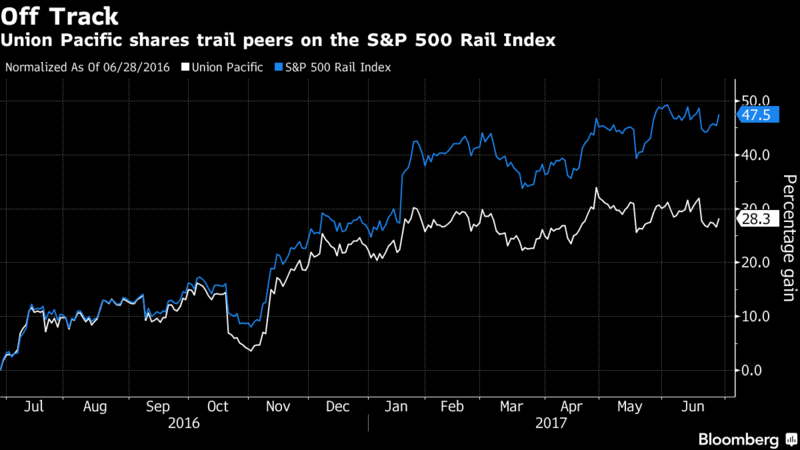
«Union Pacific Corp. sees Mexico trade as a bright spot for its rail freight growth despite tough trade talk from President Donald Trump, said Chief Executive Officer Lance Fritz.Shipments between Mexico and the U.S. have been expanding as much as 6 percent annually over the last six years and now make up about 12 percent of the railroad’s revenue, Fritz said Wednesday in an interview. Union Pacific, the largest publicly traded railroad in North America, has captured 70 percent of the U.S.-Mexico train traffic through its six border crossings, he said.»

«“Even while we struggled in volume in ’15 and ’16, we were growing with Mexico,” Fritz, 54, said at Bloomberg’s headquarters in New York. “I think there’s great opportunity there still.”»

800x-1-2

«U.S.-Mexico trade in goods soared to $524 billion last year from $81 billion in 1993, the year before the North American Free Trade Agreement took effect. Trump has called out U.S. companies for building factories south of the border and often points to the U.S. trade deficit with Mexico, which was $64 billion last year, leading him to assail the trade pact. The administration has signaled it will hold talks with Mexico to renegotiate Nafta.»

«Trump’s anti-trade comments don’t worry Union Pacific, according to Fritz, who said he has spoken with Commerce Secretary Wilbur Ross and others in the administration. Those officials are focused on fairness and bilateral deals and aren’t expected to erect significant trade barriers, Fritz said.»

«“They’re quite pragmatic and reasonable,” he said. “They understand how inextricably linked our supply chains are in Nafta and globally. They understand the value that brings to both consumers and industry and the job creation it represents for the U.S., notwithstanding there is some dislocation.”»

«Chemical Output»

«A burgeoning U.S. chemical-production boom along the Gulf of Mexico also marks a growth area for Union Pacific as new factories are built to use raw materials from shale drilling. About $30 billion of capital investment is being poured into one Texas county alone, Brazoria, near Houston, he said.»

«Union Pacific is tapping that market by building a packaging plant that will enable the railroad to transport plastic pellets from Dallas to West Coast ports for shipment to Asia. That will help fill 85,000 containers a year that now are shipped back empty to the West Coast.»

«Volume at the Omaha, Nebraska-based railroad is growing this year after dropping in 2015 and 2016, mainly as demand for coal slumped. Shipments of the fossil fuel have stabilized after it went from generating 50 percent of U.S. electricity to about 30 percent today.»

«Still, the railroad has ceded some market share to BNSF Railway Co., which is owned by Warren Buffett’s Berkshire Hathaway Inc. and is Union Pacific’s biggest rival in the western U.S. An excess of truck capacity meanwhile has put pressure on cargo volume and the ability to raise prices, Fritz said. Coal and intermodal — which is freight in containers that can be hauled by ship, truck or train — are especially susceptible to price competition.»

«“There just may be some piece of business that our competition is going to secure at a lower price than we’re willing to go,” Fritz said.»»

Bloomberg / By Thomas Black 28 de junio de 2017 12:57 GMT-5

IFR Joint Venture Tonalli Energia Qualifies for Upcoming Mexican Onshore Bid Round 2.3

Stockhouse | V.IFR CALGARY, Alberta, June 26, 2017 (GLOBE NEWSWIRE)

«International Frontier Resources Corporation (“IFR” or the “Company”) (TSX-V:IFR) (OTCQB:IFRTF) today announced that its jointly owned Mexican company Tonalli Energia (“Tonalli”) has been named by Mexico’s energy regulator, the National Hydrocarbons Commission (CNH), as one of 12 companies and seven consortiums to qualify to bid on up to 14 blocks in bid round 2.3 scheduled for July 12, 2017. Other qualifying bidders are from Mexico, Canada, the United States, China, Colombia and Uruguay.»

«As previously announced on January 19, 2017, Tonalli has been analyzing and assessing block data, and completed documentation in anticipation of entering the bidding process this July. Concessions are to be awarded under a license contract model for exploration and production that will last 30 years and can be extended for a maximum of two additional terms of five years each.»

«Round 2.3 includes 14 onshore blocks averaging 185 square kilometres (72 sections) available nationwide: six in the Southeastern Basin, four in the Burgos Basin, three in the Veracruz Basin and one block in the Tampico-Misantla Basin. Covering a total of 2,595 square kilometres, these development and exploration blocks contain 25 oil and gas fields with existing 3D or 2D seismic coverage. The Mexican government estimates that the blocks contain total prospective exploration resources of approximately 251 million barrels of crude equivalent and remaining original extraction volumes of approximately 328 million barrels of crude oil equivalent.»

«IFR was one of the first foreign companies to participate in the historic reform of Mexico’s oil and gas sector. Last year, Tonalli assumed operatorship of the Tecolutla block from state-owned PEMEX.  Tecolutla was acquired through a 50-50 joint venture with Mexican petrochemical leader Grupo IDESA in last year’s onshore block auction.»

«ABOUT INTERNATIONAL FRONTIER RESOURCES»

«International Frontier Resources Corporation (IFR) is a Canadian publicly traded company with a demonstrated track record of advancing oil and gas projects. Through its Mexican subsidiary, Petro Frontera S.A.P.I de CV (Frontera) and strategic joint ventures, it is advancing the development of petroleum and natural gas assets in Mexico.»

«The Company’s shares are listed on the TSX Venture, trading under the symbol IFR, and on the OTCQB under the symbol IFRTF. For additional information please visit www.internationalfrontier.com.»                                                                                    

«“Neither the TSX Venture Exchange nor its Regulation Services Provider (as that term is defined in the policies of the TSX Venture Exchange) accepts responsibility or accuracy of this release”. The Company seeks Safe Harbor.»
shutterstock_283702613

FOR FURTHER INFORMATION Steve Hanson – President and CEO (403) 618-7346 shanson@internationalfrontier.com or Tony Kinnon – Chairman (403) 607-6591 tkinnon@internationalfrontier.com

Stockhouse | V.IFR CALGARY, Alberta, June 26, 2017 (GLOBE NEWSWIRE)


OPEC Deepens Oil Cuts as U.S. Shale Comes Back

Bloomberg / By Brian Wingfield and Samuel Dodge / 

«The most globalized effort to cut oil production in history is proving increasingly successful. Now Iraq and Kazakhstan just need to do their bit. OPEC curbed output as promised in May, even though Iraq, the group’s second largest producer, hasn’t complied with the agreement this year. Non-OPEC nations trimming supplies are making steady gains, without help from Kazakhstan. There’s still time to improve: the cuts are set to remain in place through March.»

«OPEC Cuts Output More Than Promised»

«Thousands of barrels a day»

FullSizeRender

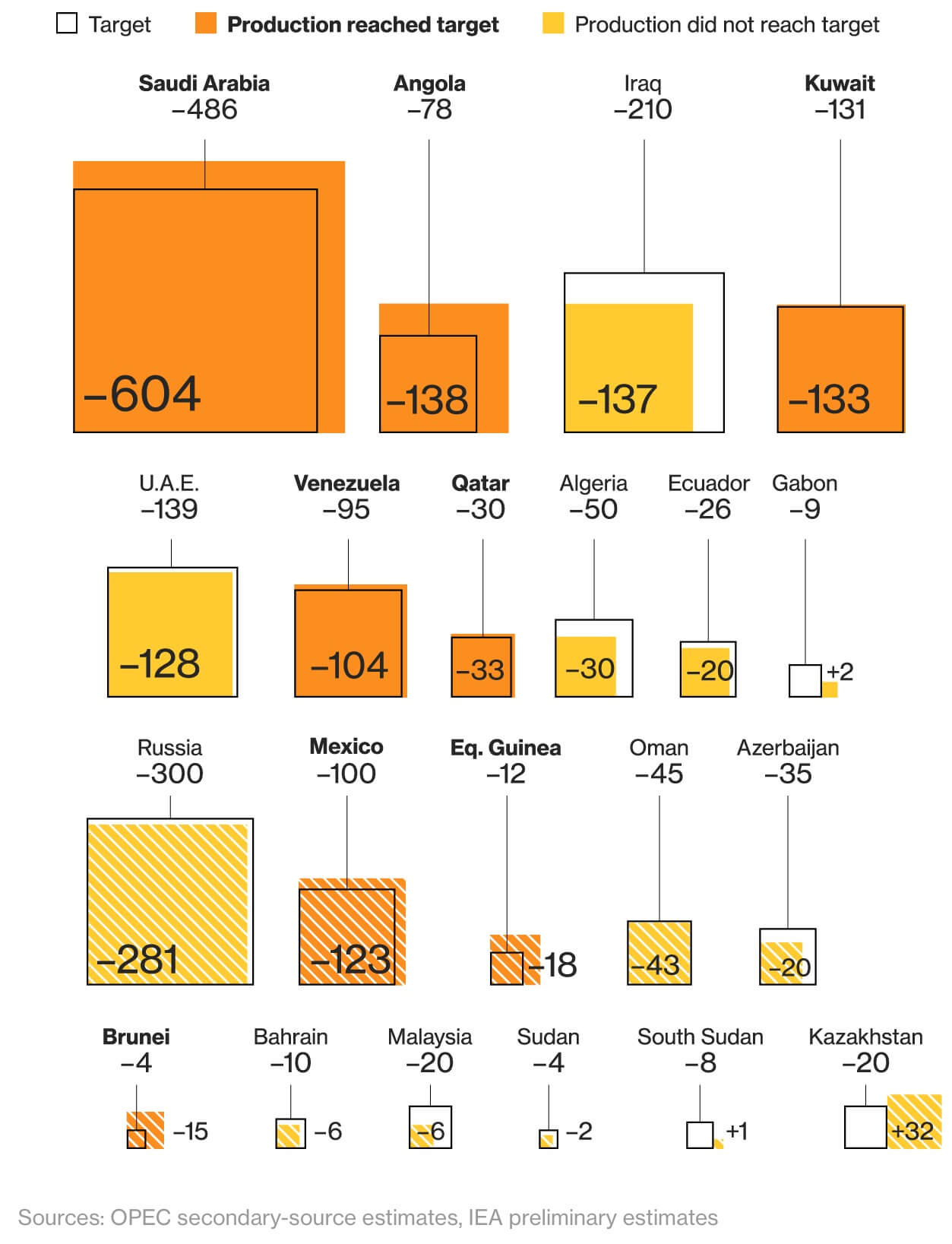
«The 21 nations participating in supply cuts are collectively trying to reduce output by almost 1.8 million barrels a day, in most cases using October levels as the starting point. Five OPEC members and three from outside the group met their targets last month, versus nine in April, revised data show. The biggest producers wield the most influence. Russia’s deeper cuts buoyed non-OPEC compliance, even if it didn’t fully meet its own pledged supply curbs.»

«Which Countries Reached Their Output Target in May?»

«Eight of 21 countries involved reached their target»
FullSizeRender (1)

«More than half of the burden for reaching the total supply-cut goal falls upon Saudi Arabia, Russia and Iraq. Only the Saudis have consistently met their target, lifting OPEC’s compliance in the process. Russia, responsible for much of the non-OPEC pledged cuts, has said it would curb output gradually. Iraq’s compliance rate in May fell to 65 percent, versus 87 percent in April, OPEC secondary source data show.»

«May Crude Oil Production»

«Thousands of barrels a day»

FullSizeRender (3)

«Kazakhstan, which is boosting output from its Kashagan oil field, again produced more crude than it pledged to do under the supply agreement. Small producers Gabon and South Sudan also pumped more than they said they would, according to OPEC and IEA data. Other nations that didn’t cut as much as promised include Algeria and Malaysia. OPEC members Libya and Nigeria are exempt from supply curbs, and Iran is allowed to boost output.»

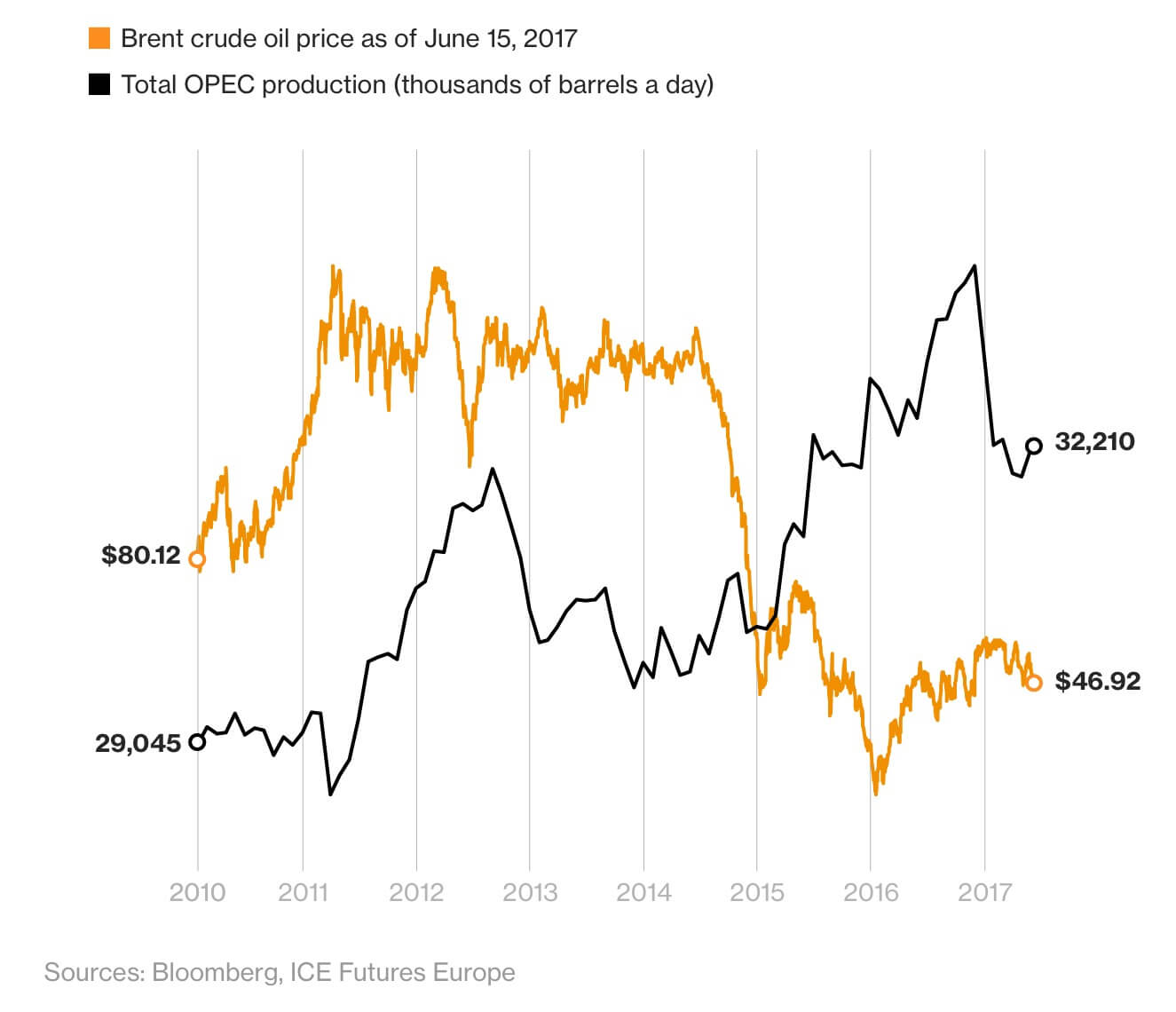
«Price and Production»

«Prices Have Fallen to Near November Levels»
FullSizeRender (4)

«By the end of May, oil prices had fallen to within cents of where they were on Nov. 30, when OPEC announced the supply cuts. That’s largely because others, notably U.S. shale producers, have ramped up output. Libya and Nigeria have also boosted production, and the IEA sees new supplies from OPEC’s rivals outpacing global demand growth next year. For OPEC and its allies, draining the world’s oil glut suddenly looks much harder.»

Bloomberg / By Brian Wingfield and Samuel Dodge / 

American energy firms are enjoying a bonanza south of the border

«A CHEMICAL engineer at Pemex, Mexico’s state-owned oil company, opens a tap atop a maritime platform in this offshore oilfield in the southern part of the Gulf of Mexico. She decants a jar of heavy Mexican crude that comes, hot to the touch, from 3,500 metres below the seabed. It looks like a succulent chocolate sauce, but smells like the back end of a cow. “Taste it,” she laughs.»

«The crude that she is testing is pumped a short distance across the sea to a vast floating storage tank, known as an FPSO, where it is blended with lighter crude for export. The FPSO stores about 2m barrels—roughly the equivalent of a day’s worth of Mexican oil production. A quarter of that is fed into a supertanker tied alongside, contracted by Chevron, America’s second-largest oil firm. It then sails north across the maritime border to Texas or Louisiana where the crude runs through refineries. The refined petrol or diesel often then returns to Mexico.»

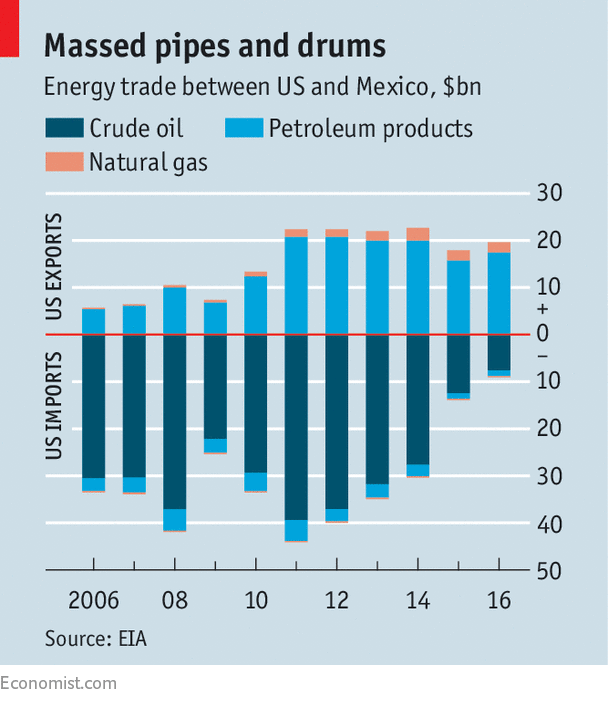
«These transactions are part of a historic transformation of North American energy that President Donald Trump appears to have overlooked as he fumes over his country’s trade deficit with Mexico and pours scorn on the North American Free Trade Agreement (NAFTA). In 2015 the energy trade balance flipped (see chart). Between 2011 and 2016, it swung from an American deficit of $20bn to an American surplus of $11.5bn. America earned almost as much from exporting hydrocarbons to Mexico as from cars and trucks.»

20170617_WBC029

«This about-turn has been caused by several factors, namely America’s shale boom, Mexico’s slumping oil output (down by more than 1m barrels a day in a decade) and energy liberalisation in 2014 that ended Pemex’s 75-year-old hegemony over the domestic oil industry. This shifting landscape has already had an effect on Pemex: a recent bump in oil prices, combined with cost-cutting, has led to its first consecutive quarterly profit in six years. The ripple effect through North America’s energy business has also been quick, and should expand—provided it is not derailed by a hamfisted effort to renegotiate NAFTA.»

«The cross-border flow of hydrocarbons is the most tangible change. Petrol from American refineries amounts to about half of Mexico’s domestic consumption. Last month Tesoro, a Texan refiner, became the first private firm to win an auction to move imported petroleum products through Pemex’s own tanks and pipelines.»

«Mexico has also become the destination of choice for surplus American natural gas, produced in the shale revolution. Sales south of the border have almost doubled since 2014, as Mexico switches its power generation from coal and oil to cheaper, cleaner fuels. The capacity of natural-gas pipelines crossing the border is expected almost to double over the next three years. Since Cheniere Energy became the first firm to export American liquefied natural gas last year, much has flowed to Mexico.»

«Investment is also flowing. American oil companies won five out of the eight blocks auctioned in Mexico’s first sale of deepwater oil licences last year. That forms part of what Pedro Joaquín Coldwell, Mexico’s energy secretary, says are $49bn-worth of international investment commitments in exploration and drilling since 2015. José Antonio González Anaya, Pemex’s boss, says he hopes to encourage American refiners such as Tesoro and Valero to co-invest in some of Mexico’s six refineries. But all were built before 1980, are decrepit, and lose about $9bn a year.»

«The changes are becoming visible at the petrol pump. ExxonMobil, America’s largest oil company, announced in May that it would open its first petrol station in Mexico this year and invest $300m in fuel distribution over the next decade. Currently, only one petrol station in Mexico is owned by a supermajor, BP (its enthusiastic pump attendants work for salaries, not tips, unlike those at Pemex-branded ones).»

«At a congressional hearing in Washington this month, experts noted that the United States, Mexico and Canada are on track to achieve North American energy independence by 2020—meaning the region will produce more liquid fuels than it consumes. Cheap, abundant energy will boost the region’s industrial competitiveness; it will also reduce its dependence on less stable producers such as Venezuela and Persian Gulf States.»

«But in both America and Mexico, uncertainties loom. The process under way to renegotiate NAFTA could jeopardise energy co-operation if Mr Trump pulls America out of the treaty, as he has threatened to do. Since Mexico’s energy liberalisation, NAFTA’s provisions have helped provide certainty to foreign investors. Those safeguards could be valuable if Andrés Manuel López Obrador, a staunch opponent of energy reform, wins Mexico’s presidential election next year. He could take issue with the growing dependence on American fuel. A vibrant network of North American energy markets is taking shape, but it remains fragile—especially with populists blundering about in positions of power.»

shutterstock_266679740

Mexico Said to Take First Steps in Annual Oil Hedging Program

by Nacha Cattan and Javier Blas / 9 de junio de 2017 11:23 GMT-5

  • «Mexico said to ask banks for options quotes to fix 2018 prices

  • «Mexico annual sovereign hedge is Wall Street largest oil deal

«Mexico has taken the first step in its annual oil hedging program, asking Wall Street banks for price quotes on the put options it buys to lock in prices for the following year, according to people familiar with the matter.»

«Mexico usually buys put options from a small group of investment banks, starting as early as May but sometimes as late as July, in what’s considered Wall Street’s largest — and most secretive — annual oil deal.»

«The country started asking for quotes from banks as recently as late last week, the people said, asking not to be named because the information is confidential. The people didn’t say whether Mexico executed a trade after receiving the quotes. The Ministry of Finance declined to comment.»

«The Mexican oil hedge, which typically covers between 200 million and 300 million barrels, has the potential to roil the market as the banks writing the put options for the country’s ministry of finance hedge themselves in the market by selling oil and refined products futures and swaps.»

800x-1

«The put options give Mexico the right, but not the obligation, to sell oil at a predetermined price and time. The hedge runs from December to November.»

«Oil options traders and brokers detected trading activity last Thursday and Friday that in the past has been associated with the banks behind the Mexican oil hedge laying down some of their own risk.»

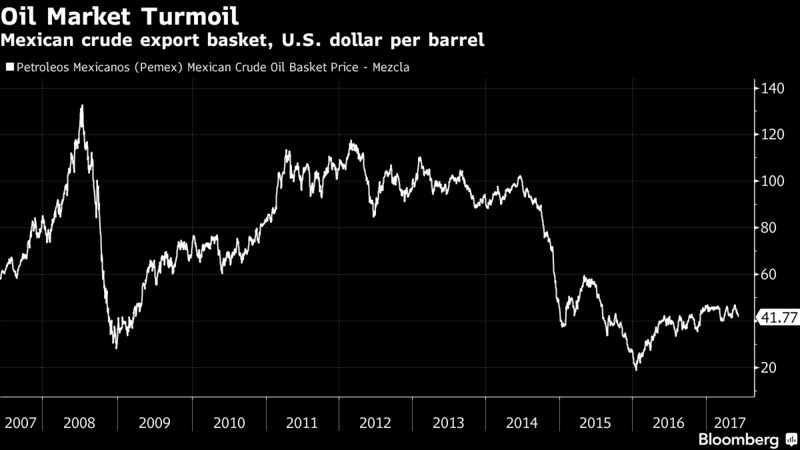
«Last year, the Mexican government spent $1 billion buying put options to lock in an average price for its export basket of $38 a barrel for 2017. Year-to-date, the Mexican export basket has averaged $44 a barrel. In addition, Petroleos Mexicanos, the state-owned oil company better known as Pemex, also hedged some of its production for 2017, spending nearly $134 million buying a put option spread that gives it protection if prices drop below $42 a barrel.»

Handsome Payouts

«The Latin American country has received handsome payouts from its oil hedging program, earning a record $6.4 billion in 2015 after OPEC embarked on a war for market share that sent prices tumbling. Mexico made $5 billion in 2009, after the global financial crisis, and another $2.7 billion in 2016.»

«Since the modern oil hedge program started in 2001, Mexico has made a profit of $2.4 billion — its hedges raked in $14.1 billion in gains and paid out $11.7 billion in fees to banks and brokers. The country also made money in the 1990s, when the hedge wasn’t done on an annual basis.»

«Despite Mexico’s hedging success, few other commodity-rich countries have followed suit. Ecuador hedged oil sales in 1993, but losses triggered a political storm and the nation never tried again. More recently, oil importers Morocco, Jamaica and Uruguay have bought protection against rising energy prices, but their deals had been relatively small.»

«Mexico last year started hedging in late May as oil prices peaked after a soft start to the year. This time, however, oil prices are declining after a relatively strong start to 2017. Brent crude, the global benchmark, peaked at $57.10 a barrel in early January and approached those highs in April. But since then it has weakened to trade below $48 on Friday.»
«Mexico has traditionally used banks including JPMorgan Chase & Co., Goldman Sachs Group Inc., Morgan Stanley, Barclays Plc, Citigroup Inc. and BNP Paribas SA for its annual hedge, according to government documents. Last year, the trading unit of Royal Dutch Shell Plc became the first known non-bank to join the hedge, according to people familiar with the matter.»

by Nacha Cattan and Javier Blas / 9 de junio de 2017 11:23 GMT-5

From: Bloomberg

Por primera vez, SENER abrirá a privados licitación en gas y petróleo tipo shale

HUFFPOST |08/06/2017 5:19 PM CDT | Actualizado 08/06/2017 5:20 PM CDT

«Por primera vez, la Secretaría de Energía (Sener) abrirá a la inversión privada la licitación para el desarrollo de campos petroleros que contienen gas y petróleo tipo shale.»

«El secretario de energía, pedro Joaquín Coldwell, informó que en julio se anunciará la licitación de este tipo de recursos petroleros, publicó el periódico El Universal.«

«Según datos de la Sener, el recurso no convencional de hidrocarburos con mayor potencial en México son el shale gas y el shale oil, producidos a partir de formaciones compuestas por lutitas.»

«El país tiene la sexta mayor reserva de gas shale del mundo, según Coldwell.»

«La Agencia Internacional de Energía estima que los volúmenes pueden ser cercanos a 60.21 miles de millones de barriles de petróleo crudo equivalente de recursos no convencionales de gas y petróleo shale.»

«Durante el Congreso Mexicano del Petróleo 2017, Coldwell dijo que la estabilidad de precios del petróleo en el mercado internacional «hace posible que ahora sí podamos licitar estos campos».»

«Desde la aprobación de la reforma energética, el gobierno federal había contemplado licitar bloques productores de gas y petróleo shale, pero los altos precios los hicieron poco rentables para los inversionistas.»

HUFFPOST |08/06/2017 5:19 PM CDT | Actualizado 08/06/2017 5:20 PM CDT

Fuente: HUFFPOST

Repsol Said to Mull Entry Into Mexico’s Newly Opened Fuel Market

  • Company is conducting market study; has met with regulators

  • Spanish firm could make a decision as soon as next month

«Repsol SA, Spain’s biggest oil company, is studying Mexico’s nascent fuel market as it considers whether to open gas stations in the country, people familiar with the plans said.»

«Repsol could make a decision as soon as next month, one of the people said. A Repsol press officer declined to comment. A spokeswoman at Mexico’s energy regulatory commission, or CRE, said that some commissioners met with Repsol in February.»

«If it proceeds, Repsol would be following in the footsteps of companies such as Exxon Mobil Corp., BP Plc, and Glencore Plc, that have recently announced plans to invest in Mexico’s fuel retail market, taking advantage of rules allowing firms other than state-owned Petroleos Mexicanos to import fuel since April 2016. «

«The Madrid-based firm, which has a refinery and network of more than 400 service stations in Peru, is only likely to be interested in markets where it can have a five percent share or more, one of the people said.»

PEMEX«Mexico’s recent energy industry opening was designed to lure investment and bring competition to a market formerly controlled by Pemex. However, the gradual elimination of fuel subsidies this year has also sparked social unrest as prices at the pump increased by as much as 20 percent in some regions in January.»

«The slow pace of new regulations and infrastructure hurdles has meant that companies continue to rely on Pemex’s pipeline and terminals to transport and store fuel, as well as to supply it in many cases.»

«Repsol has had a rocky relationship with Pemex, which sold a stake of about eight percent in the Spanish firm in 2014, valued at $2.8 billion. The sale followed a lengthy dispute between the companies’ boards of directors, with Pemex citing differences over corporate governance as one of the factors that led to the fallout, according to a statement at the time. «