Trump, Mexico expect progress in stalled NAFTA talks

Investing / Reuters / Anthony Esposito and Adriana Barrera / July 24


PUERTO VALLARTA, Mexico (Reuters) – U.S. President Donald Trump spoke warmly of Mexico’s incoming leftist president on Monday, saying he expected to get «something worked out» on NAFTA, while a top Mexican official said there was scope to revive the trade talks this week.

«We’re talking to Mexico on NAFTA, and I think we’re going to have something worked out. The new president, terrific person,» Trump said in a speech at the White House about American manufacturing.

«We’re talking to them about doing something very dramatic, very positive for both countries, he said, without giving more details.

Talks to reshape the 1994 trade accord have been underway since last August. But they stalled in the run-up to the July 1 presidential election in Mexico, which produced a landslide victory for veteran leftist Andres Manuel Lopez Obrador.

The United States, Mexico and Canada have been at odds over U.S. demands to impose tougher content rules for the auto industry, as well as several other proposals, including one that would kill NAFTA after five years if it is not renegotiated.

Mexican Economy Minister Ildefonso Guajardo, who last week expressed hope an agreement in principle on NAFTA could be reached by the end of August, is due to hold talks with U.S. Trade Representative Robert Lighthizer at the end of the week in Washington.

He will be accompanied by Jesus Seade, the designated chief NAFTA negotiator of the incoming Mexican administration.

«There’s clearly a window of opportunity to be able to bed down a series of open issues which are not numerous, but are very complex,» Guajardo said on the sidelines of a summit of the Pacific Alliance trade bloc in the western coastal city of Puerto Vallarta.

Guajardo is due to meet his Canadian counterpart Chrystia Freeland on Wednesday, also to discuss NAFTA.

After the election, top officials from both the outgoing and new Mexican governments met in Mexico City with senior Trump administration officials led by Secretary of State Mike Pompeo.

Seade said the visit had sent out «excellent» signals.

«We hope these signals translate into a willingness to move forward,» Seade told reporters in Puerto Vallarta.

The talks have been clouded by tit-for-tat measures over trade after the Trump administration slapped tariffs on U.S. steel and aluminum imports.

The United States is also exploring the possibility of imposing tariffs on auto imports, though Guajardo said it was too early to speculate on how that would play out.

Mexico’s foreign ministry said on Monday that South Korea had initiated the process of seeking associate membership in the Pacific Alliance, which comprises Colombia, Chile, Mexico and Peru and is seeking to deepen free trade.

Singapore, Australia, New Zealand and Canada were last year admitted as associate members by the alliance. For Mexico, the expansion is part of a push to diversify its trading partners in the wake of Trump’s previous threats to pull out of NAFTA.

Guajardo indicated that despite his optimism about reaching a deal, risks still exist.

«The biggest risk is that instead of moving forward with an agenda of opening and integration, we move backwards, closing our economy and really undoing what we’ve built in the last two and a half decades,» Guajardo said.


Investing / /Reuters / Anthony Esposito and Adriana Barrera / July 24

 

First Phillips 66 Sites Open in Mexico

CSP Daily News / July 23 


EL PASO, Texas — Phillips 66 is opening its first retail sites in Mexico.

The Houston-based refiner, which owns the Phillips 66, 76 and Conoco brands, has a licensing agreement with fuel distributor Windstar LPG to open and operate branded sites in eight northern Mexican states, according to Arizona Public Media (AZPM). The first locations—three 76 branded sites—opened in Hermosillo, Sonora, on July 12. Another site was opening soon after in Chihuahua.

Reynold Gonzalez, CFO for El Paso, Texas-based Windstar, told AZPM that the company has «aggressive plans» for expanding in Mexico, with 25 to 30 branded locations slated for Sonora by the end of 2018.

Phillips 66 follows other U.S. and international refiners in entering the newly deregulated fuel market in Mexico, including ExxonMobil, Shell, Andeavor and BP.

Some industry observers have questioned whether Mexico’s new president-elect, Andres Manuel Lopez Obrador, might reverse the energy reforms launched in 2013 by his predecessor, Enrique Pena Nieto, which included opening up the fuel market to foreign companies. Lopez Obrador said he would review the reforms if he discovered corruption in how contracts were awarded, Reuters reported; however, he has not announced any plans for rollbacks since winning the election in July.

Gonzalez of Windstar told AZPM that his company would not be opening locations in Mexico if it was concerned about a rollback, and that he believes U.S. competitors could help improve the quality of gasoline for fuel customers in Mexico.

«We are an example of a positive result of the energy reform act,» he said.


CSP Daily News / July 23 


California-based energy company building $150 million Mexico fuels terminal

Chron / Rye Druzin, Staff Writer / July 12


A California energy company is moving ahead with a $150 million fuels terminal in the Mexican state of Sinaloa.

Sempra Energy of San Diego is building the fuels terminal in Topolobampo, Mexico through its Mexican subsidiary Infraestructura Energética Nova, S.A.B. de C.V. or IEnova after the company secured a 20 year contract with the Topolobampo Port Administration.

The first phase of the project will have a storage capacity of 1 million barrels for fuels including gasoline and diesel. Sempra Energy expects operations to start in the fourth quarter of 2020.

In April Sempra Energy announced that IEnova would build a $130 million, 1 million barrel fuels terminal at Ensenada, a city in the Mexican state of Baja California.

San Antonio refiner Valero Energy Corp., the largest independent refiner in the U.S., signed a deal in August with IEnova to export refined product into Mexico. The gasoline, diesel and jet fuel would ship to new $155 million storage terminals IEnova will build in the Gulf of Mexico port city of Veracruz. Other storage terminals will be constructed in Puebla, southeast of Mexico City, and in Mexico city itself, to the tune of $120 million.


Chron / Rye Druzin, Staff Writer / July 12


interview-with-graciela-alvarez-ceo-of-nrgi-broker

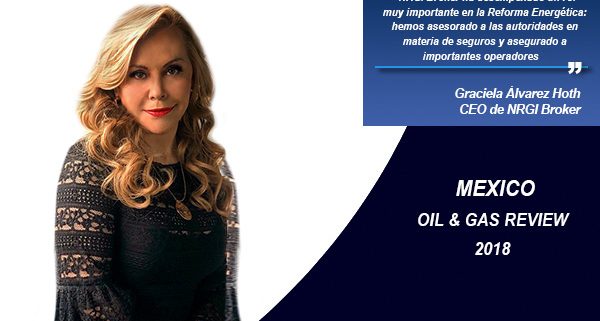
Interview with Graciela Álvarez, CEO of NRGI Broker

Mexico Oil & Gas Review / 18 Julio


Company bio: NRGI Broker specializes in insurance and surety bonds for the Mexican energy sector. It develops custom-made solutions for companies operating in the energy sector, including vessel, construction and engineering and catastrophic risks.


Q: How has NRGI Broker created market opportunities to expand the reach of its services?

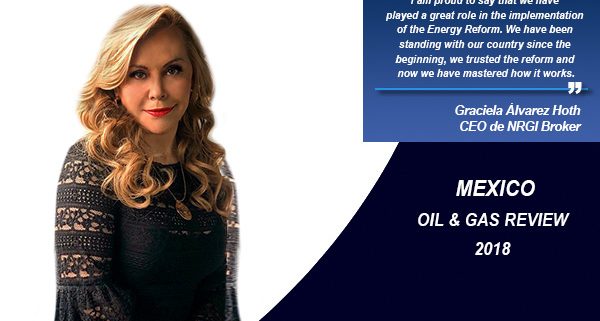
A: I am proud to say that we have played a great role in the implementation of the Energy Reform. We have been standing with our country since the beginning, we trusted the reform and now we have mastered how it works. We are a Mexican broker that  has a broad services portfolio and we have consolidated as the best one in the market We have also established “Voces de Energía”, a forum where experts discuss the reform’s environmental, social and fiscal regulations.

Q: How will NRGI Broker benefit its potential clients and partners going forward?

A: In the long term, we see the company as a consolidated reference in the fields of insurance and sureties for the oil and gas industry. We are savvy about the needs of the companies along the entire value chain in hydrocarbons and we are an established adviser for risk management and on financial regulations. We started strong in offshore, ever since activity began in that area, and now we are talking about moving into onshore. The trend is to set new partnerships for storage, pipelines, clean energies and alike. We are investing in putting our brand’s name out there and showcasing that we offer a full range of services few other companies offer.

Q: What are the Top 3 successes of the Energy Reform?

A: I have a vivid memory of observing the Energy Reform’s application when I was acting as an adviser for ASEA in 2014, which gave me the chance to understand how the reform was set in motion. The first success was the implementation itself, which was accomplished according to the same spectrum of norms, rules and opportunities. The second success was the establishment of strong and transparent organisms to guide the implementation that facilitated the cohabitation of all different players in a single environment, which has grown to represent 18 operators. The third is the 72 percent rate of successful allocation of everything that has been tendered in the licensing rounds, demonstrating the genuine interest that local and foreign companies have in Mexico.

Q: How have local and foreign companies adapted to the new regulations and what have been the major hurdles in this process?

A: Everything comes down to an understanding that we need a unified regulatory framework and this cannot be implemented without looking at international standards. The reform’s planning was based on the experiences of seven countries that underwent similar processes, so it is molded to global requirements. Those international players that recently entered the market are used to these types of regulations since they apply to other territories, while many Mexican companies have previously worked with foreign partners that use those standards. For most local companies, application was not an issue. On the contrary, companies operating in the hydrocarbons sector now have the certainty of working in an environment protected by a well-established regulatory framework.

Q: How has NRGI Broker contributed to changing the local mindset and raising awareness about the need for insurance?

A: We advised ASEA when it conducted a three-year study on the best practices and experiences of Australia, Brazil, Canada, Colombia, Norway, the UK and the US that could be applied to the Mexican case. We worked with it every step of the way to establish these rules, from offshore platforms to setting up gas stations, and we developed the administrative dispositions for insurance in the upstream, midstream and downstream sectors. Insurance is required if this industry is to function properly and this mandatory status made things easier for us in terms of application. We are certain about the need to transform the attitude toward insurance and to combine that with our experience, specialization and innovation to offer personalized solutions to our clients.

Q: How will PEMEX’s migration projects make the company more competitive and productive?

A: This is a great strategy for PEMEX to establish investment partnerships that are specialists in how fields work, the reserves included in those fields and the different options to exploit them. This is a long-term investment business that opens the door to new opportunities to turn PEMEX into a more competitive entity. It is a win-win situation. It is important to note that PEMEX gets to keep the land ownership for these migrations; they only allow investment from third parties. One of the company’s future strengths lies in its capitalization and the establishment of partnerships with technology-driven companies. By binding all the parties involved in these type of projects, the companies are forced to bring their A game and deliver on their promises because they would harm themselves if they fell short due to the interdependence ingrained in this framework.

Q: What direction would you like the next administration to follow related to the industry?

A: I hope the next administration understands the implication of keeping the Energy Reform afloat. The reform was meant to contribute to the country and it has been set in motion successfully. The next president should push for new partnerships to continue deepening the reform’s outreach. What is important to understand is that reversing this process would be harmful to the country and it would hurt many companies that have supported and invested in its application.


Para leer la edición 2018, da clic aquí.


Mexico Oil & Gas Review / 18 Julio


Interview with Graciela Álvarez, CEO of NRGI Broker

Mexico Oil & Gas Review / July 18


Company bio: NRGI Broker specializes in insurance and surety bonds for the Mexican energy sector. It develops custom-made solutions for companies operating in the energy sector, including vessel, construction and engineering and catastrophic risks.


Q: How has NRGI Broker created market opportunities to expand the reach of its services?

A: I am proud to say that we have played a great role in the implementation of the Energy Reform. We have been standing with our country since the beginning, we trusted the reform and now we have mastered how it works. We are a Mexican broker that  has a broad services portfolio and we have consolidated as the best one in the market We have also established “Voces de Energía”, a forum where experts discuss the reform’s environmental, social and fiscal regulations.

Q: How will NRGI Broker benefit its potential clients and partners going forward?

A: In the long term, we see the company as a consolidated reference in the fields of insurance and sureties for the oil and gas industry. We are savvy about the needs of the companies along the entire value chain in hydrocarbons and we are an established adviser for risk management and on financial regulations. We started strong in offshore, ever since activity began in that area, and now we are talking about moving into onshore. The trend is to set new partnerships for storage, pipelines, clean energies and alike. We are investing in putting our brand’s name out there and showcasing that we offer a full range of services few other companies offer.

Q: What are the Top 3 successes of the Energy Reform?

A: I have a vivid memory of observing the Energy Reform’s application when I was acting as an adviser for ASEA in 2014, which gave me the chance to understand how the reform was set in motion. The first success was the implementation itself, which was accomplished according to the same spectrum of norms, rules and opportunities. The second success was the establishment of strong and transparent organisms to guide the implementation that facilitated the cohabitation of all different players in a single environment, which has grown to represent 18 operators. The third is the 72 percent rate of successful allocation of everything that has been tendered in the licensing rounds, demonstrating the genuine interest that local and foreign companies have in Mexico.

Q: How have local and foreign companies adapted to the new regulations and what have been the major hurdles in this process?

A: Everything comes down to an understanding that we need a unified regulatory framework and this cannot be implemented without looking at international standards. The reform’s planning was based on the experiences of seven countries that underwent similar processes, so it is molded to global requirements. Those international players that recently entered the market are used to these types of regulations since they apply to other territories, while many Mexican companies have previously worked with foreign partners that use those standards. For most local companies, application was not an issue. On the contrary, companies operating in the hydrocarbons sector now have the certainty of working in an environment protected by a well-established regulatory framework.

Q: How has NRGI Broker contributed to changing the local mindset and raising awareness about the need for insurance?

A: We advised ASEA when it conducted a three-year study on the best practices and experiences of Australia, Brazil, Canada, Colombia, Norway, the UK and the US that could be applied to the Mexican case. We worked with it every step of the way to establish these rules, from offshore platforms to setting up gas stations, and we developed the administrative dispositions for insurance in the upstream, midstream and downstream sectors. Insurance is required if this industry is to function properly and this mandatory status made things easier for us in terms of application. We are certain about the need to transform the attitude toward insurance and to combine that with our experience, specialization and innovation to offer personalized solutions to our clients.

Q: How will PEMEX’s migration projects make the company more competitive and productive?

A: This is a great strategy for PEMEX to establish investment partnerships that are specialists in how fields work, the reserves included in those fields and the different options to exploit them. This is a long-term investment business that opens the door to new opportunities to turn PEMEX into a more competitive entity. It is a win-win situation. It is important to note that PEMEX gets to keep the land ownership for these migrations; they only allow investment from third parties. One of the company’s future strengths lies in its capitalization and the establishment of partnerships with technology-driven companies. By binding all the parties involved in these type of projects, the companies are forced to bring their A game and deliver on their promises because they would harm themselves if they fell short due to the interdependence ingrained in this framework.

Q: What direction would you like the next administration to follow related to the industry?

A: I hope the next administration understands the implication of keeping the Energy Reform afloat. The reform was meant to contribute to the country and it has been set in motion successfully. The next president should push for new partnerships to continue deepening the reform’s outreach. What is important to understand is that reversing this process would be harmful to the country and it would hurt many companies that have supported and invested in its application.


To read the 2018 edition click here.


Mexico Oil & Gas Review / July 18


US launches five dispute actions in WTO challenging China, EU, Canada, Mexico and Turkey

Merco Press / REUTERS / Yuri Gripas / 17 July


The United States launched five separate World Trade Organization dispute actions on Monday challenging retaliatory tariffs imposed by China, the European Union, Canada, Mexico and Turkey following U.S. duties on steel and aluminum. The retaliatory tariffs on up to a combined US$28.5 billion worth of U.S. exports are illegal under WTO rules, U.S. Trade Representative Robert Lighthizer said in a statement.

“These tariffs appear to breach each WTO member’s commitments under the WTO Agreement,” he said. “The United States will take all necessary actions to protect our interests, and we urge our trading partners to work constructively with us on the problems created by massive and persistent excess capacity in the steel and aluminum sectors.”

Lighthizer’s office has maintained that the tariffs the United States has imposed on imports of steel and aluminum are acceptable under WTO rules because they were imposed on the grounds of a national security exception.

Mexico said it would defend its retaliatory measures, saying the imposition of U.S. tariffs was “unjustified.”

“The purchases the United States makes of steel and aluminum from Mexico do not represent a threat to the national security,” Mexico’s Economy Ministry said in a statement.

“On the contrary, the solid trade relationship between Mexico and the U.S. has created an integrated regional market where steel and aluminum products contribute to the competitiveness of the region in various strategic sectors, such as automotive, aerospace, electrical and electronic,” the ministry added.

Lighthizer said last month that retaliation had no legal basis because the EU and other trading partners were making false assertions that the U.S. steel and aluminum tariffs are illegal “safeguard” actions intended to protect U.S. producers.


Merco Press / REUTERS / Yuri Gripas / 17 July


México preparado para negocios de innovación financiera

Contramuro / 16 julio


Se cierra la legislatura con mejoras para evitar robo de hidrocarburos, sin impuestos en alimentos y medicinas, y reglas para evitar endeudamiento público

Ciudad de México.-Con avances en la regulación, modernización y vigilancia del sistema fiscal, de aduanas, financiero y gasto público, concluyó el trabajo de la Comisión de Hacienda y Crédito Público, de la LXII y LXIII legislatura, señaló su presidente, senador Manuel Cavazos Lerma.

El avance que se dio para modernizar a México en materia tecnológica en el rubro financiero, se dio con la elaboración de la llamada Ley Fintech, publicada en el Diario Oficial de la Federación (DOF), el 9 de marzo, recordó.

Así quedaron regulados los servicios financieros que prestan las instituciones de tecnología financiera, su organización, operación y funcionamiento y los servicios financieros sujetos a alguna normatividad especial ofrecidos o realizados por medios innovadores, como las plataformas tecnológicas que operan criptomonedas.

Con la nueva regulación, el país se coloca como líder en América Latina, al sumar 238 startups que ofrecen servicios financieros a través de la tecnología, y se espera que el valor total de las transacciones sea de alrededor de los 36 mil millones de dólares para 2018.

Recordó que en abril de este año, fueron aprobadas diversas modificaciones al Código Fiscal de la Federación, a la Ley Aduanera, al Código Penal Federal y a la Ley Federal para Prevenir y Sancionar los Delitos cometidos en materia de hidrocarburos para contar con controles volumétricos que verifiquen la entrada y salida en toda la cadena productiva de hidrocarburos y petrolíferos.

Dichas modificaciones ayudan a combatir la evasión y elusión fiscal, y la venta de gasolinas producto del contrabando, porque  el nuevo sftwaremide el volumen del producto recibido en los servicios que desarrollan los permisionarios de transporte, almacenamiento y distribución, hasta su venta final.

Otro de los cambios importantes en esta legislatura, dijo, fue a la Ley Aduanera, en la que se fijó la modernización de los procesos de declaración de los viajeros que entran al país, éstos se realizarán con de forma flexible y con nuevas tecnologías.

No impone nuevos regímenes fiscales, únicamente se actualiza para reducir el uso de papel y certificar el peso, volumen y calidad de mercancías que ingresan a territorio nacional, comentó.

Por primera vez, se ratificó el nombramiento de una mujer, Úrsula Carreño Colorado, para ocupar el cargo de Subsecretaria de Egresos de la Secretaría de Hacienda y Crédito Público (SCHP).

En materia de finanzas públicas, se aprobó, en 2017, la Ley de Disciplina Financiera de las Entidades Federativas y los Municipios para establecer reglas y controles para la contratación de deuda pública, a fin de evitar desfalcos de los recursos públicos ejercidos y endeudamiento sin control.

El senador recordó que se fijó el cinco por ciento de los excedentes para gasto corriente de forma permanente, a partir del año 2019 y se establecieron facilidades para atender de manera ágil las necesidades de los estados en caso de desastres naturales.

Por otra parte, señaló que la reforma hacendaria de 2013, fortaleció la capacidad financiera del Estado, ayudó a simplificar el pago de impuestos, eliminó el Impuesto Empresarial a Tasa Única (IETU) y el Impuesto a Depósitos en Efectivo (IDE) y se mantuvo la exención de IVA a alimentos y medicinas.

Cavazos Lerma agregó que los acuerdos al interior de la Comisión permitieron la aprobación de la Ley de Ingresos que envía la colegisladora, para su revisión, en octubre de cada año, con lo cual se determina el monto de los recursos con los que contará la Federación y que se etiquetan en los diferentes rubros del país, a través del Presupuesto de Egresos.


Contramuro / 16 julio


¿Cómo debe ser el nuevo CEO de Pemex?

El Financiero / Daniela Loredo / 16 julio


Los expertos consideran que además de provenir de la iniciativa privada, el nuevo líder de la petrolera deberá contar con experiencia para tomar decisiones.

Aunque son tres nombres los que ‘suenan’ para sustituir a Carlos Treviño, actual director de Pemex, en el próximo gobierno de Andrés Manuel López Obrador, expertos definieron el perfil que debe cumplir el nuevo capitán de la petrolera nacional.

Para Arturo García, socio de Energía y Recursos Naturales de Deloitte, el próximo dirigente de la empresa productiva del Estado “debe ser extraído de la iniciativa privada ya sea mexicana o extranjera, además de tener la experiencia que Pemex requiere”, apuntó en entrevista.

De manera extraoficial quienes suenan para ocupar el cargo son Fluvio Ruiz Alarcón, exconsejero independiente de Pemex; Mario Delgado Carrillo, senador y economista colimense; y Octavio Romero Oropeza, Oficial Mayor de Andrés Manuel López Obrador durante su gestión como jefe de gobierno de la Ciudad de México.

En ese sentido, Arturo Carranza, asesor en energía del Instituto Nacional de la Administración Pública, señaló que de ser elegido, Romero Oropeza, a quien se ha señalado como el de mayor predilección para ocupar el cargo, le permitiría tomar decisiones que sacudan a la empresa y que permitan fortalecerla.

“Se requiere un director que tenga toda la confianza del presidente y por ese lado el perfil de Oropeza embona perfectamente a la par que tiene conocimientos financieros”, señaló.

Luis Miguel Labardini, analista de Marcos y Asociados, señaló que desafortunadamente los nombramientos hasta ahora han sido de carácter político. 

El Financiero / Daniela Loredo / 16 julio

Amlo and the realities of Mexico’s oil reform

Petroleum Economist / Craig Guthrie / July 9


The Mexican president-elect needs a strong oil and gas sector to fund a promised social transformation

The investor-friendly tone Mexican president-elect Andres Manuel Lopez Obrador, widely known as Amlo, struck in the run-up to his landslide victory on 1 July is fueling confidence he will tweak rather than dismantle the energy reforms that are enticing international oil companies to the country.

Prospects of an Amlo presidency had stirred concerns among investors for months ahead of the vote—he’s the first leftist Mexican president since the 1930s, and has forged an anti-elitist platform calling for a reordering of the political landscape. And yet the peso gained more than 2% against the US dollar in the hours after the result.

«This can be a presidency ruled by reason and legality,» Ixchel Castro, manager of Latin American oils and refining markets research with Wood Mackenzie, tells Petroleum Economist, while pointing to the currency market’s reaction and the links he’s built with Mexican business elites. «There may be change in the emphasis of the energy reforms, but we see a reversal as highly unlikely».

Launched by outgoing President Enrique Peña Nieto in 2013, the reforms ended Pemex’s 75-year monopoly over the energy sector. So far, auctions in January and March jointly lured at least $100bn in oil exploration investment commitments from more than 70 different firms—useful revenue for a president who has promised sweeping social changes to tackle crime, corruption and poverty.

Amlo made opposition to the reforms a bedrock of his failed 2013 presidential bid, and told a rally just four months ago that he would never allow Mexican crude to return to the hands of foreigners. But a reversal in tack since has seen his top business adviser and nominee for chief of staff, Alfonso Romo, lead a pro-business public relations drive towards international investors.

Romo told Reuters on 25 June that there could be more auctions of oil drilling rights, as long as a review of contracts that have already been awarded to private companies showed no problems. «We will revise them and everything good will remain,» he said, noting that Amlo had said this directly to investors in New York.

But it’s not expected to be all smooth sailing for foreign oil investment under Amlo’s watch. Uncertainty over the long-term goals of his populist agenda will likely continue to unnerve companies looking to establish a steady pipeline of projects.

«Amlo will likely enjoy the benefits from the existing contracts that have been awarded, especially in terms of oil barrels produced, fiscal revenue received and jobs created. By the third year of his administration he can claim that Mexico is producing more oil under his presidency,» Duncan Wood, director of the Mexico Institute at the Woodrow Wilson International Centre wrote in an e-mail.

«But he will be reluctant to continue the bidding rounds. The one possible exception that I see would be in deep waters and in farm-outs from Pemex.»

Mexico plans to auction 37 onshore areas and nine in the shale gas-rich Burgos Basin on 27 September, as well as the farm-out of seven onshore areas with Pemex on 31 October.

Amlo’s approach to a planned re-shaping of Pemex is seen as the next critical indicator of his eventual intentions on the country’s energy direction.

While the president has pledged to resurrect Pemex into a strong national oil company through cost-cutting, this comes amid a significant decline in domestic energy production—from 3.4m barrels of oil a day in 2004 to 1.9m b/d in 2018.

«Pemex must be forced to compete in order to become stronger,» said Wood. «If the reform process is stopped, Pemex would gain from a strengthening of its position in the short-term. But in the long term its competitiveness and productivity could be severely damaged.»


Petroleum Economist / Craig Guthrie / July 9


Mexico Likely To Keep Making The World’s Biggest Oil Hedge

Baystreet Staff / Tsvetana Paraskova / Oilprice / July 9


The Mexican oil hedge, or the Hacienda Hedge, is considered the biggest hedging bet on Wall Street as well as perhaps the most secretive. It has earned Mexico—and a few large investment banks—billions of U.S. dollars.

Mexico buys put options from investment banks and typically hedges a whopping 200-300 million barrels of oil a year. With the put options, it has the right, but not the obligation, to sell oil at a previously set price and timing. But will this tradition continue under the newly elected administration?

Throughout his campaign, Mexico’s now president-elect Andres Manuel Lopez Obrador kept the oil industry on edge with comments and promises that he would review the landmark 2013 energy reform of outgoing President Enrique Peña Nieto that ended seven decades of oil monopoly in the country.

But the first signals from Lopez Obrador’s staff and advisors after he won Mexico’s presidential election last weekend are that the new president would not seek to backtrack on the energy reform, which allowed foreign oil firms to win contracts to pump Mexican oil.

Leftist Lopez Obrador and the new government, set to take office on December 1, will also likely continue with Mexico’s annual oil hedging program—considered to be the biggest annual oil hedge deal on Wall Street—an economic advisor to the president-elect told Bloomberg this week.

For 2018, Mexico locked in last year an average export price of US$46 per barrel of crude oil with its oil hedge. According to data by Mexico’s Finance Ministry, the country spent the equivalent of around US$1.25 billion on the oil hedge program for 2018, which was 21 percent higher than the oil hedge in 2016 to lock in prices for 2017. Mexico’s spending on the world’s biggest oil hedge has been at around US$1 billion over the past few years. State-run Petroleos Mexicanos (Pemex) is also hedging part of its production.

According to a member of president-elect Lopez Obrador’s economic team, Mexico’s oil hedge and the Pemex hedge are “working fine” and are likely to be left unchanged.

“The formula by which the government is calculating the price of oil is a very stable formula,” Abel Hibert told Bloomberg. “Using the hedges reduces uncertainty in financial markets,” the economic advisor said, adding, however, that the hedging program was not mentioned when energy policies were discussed at a meeting of the transition team this week.

Reducing uncertainty seems to be the key message from Lopez Obrador’s team after the election, even beyond the hedging program for oil.

Alfonso Romo, who is tipped to be the next president’s chief of staff, says that the new administration doesn’t want to create uncertainty and that there won’t be rescinding of the energy reform.

“What do we want to do? We want to take advantage of all of the enthusiasm we’ve generated to fix everything we can,” Romo told Bloomberg in an interview. “What don’t we want? To create uncertainty. Zero. I’m terrified of that.”

The incoming president’s chief of staff also said that he didn’t see changes to the 2013 reform.

“If anything happens, it would be done without hurting private investment,” Romo told Bloomberg.

With the energy reform of the outgoing president Peña Nieto, Mexico has attracted oil majors of the likes of ExxonMobil, Chevron, Shell, and Eni to its offshore areas, as it seeks to reverse a decline in its oil production.

Mexico needs a lot of money for offshore drilling, and “no one will fight success” if it manages to boost oil production, according to Romo.

The president-elect Lopez Obrador has said that he would have the already awarded contracts scrutinized for irregularities. But neither Romo nor the likely incoming finance minister Carlos Urzua expects the review of the contracts to reveal acts of corruption.

“If it looks good, on we go. It’s a contract we have to respect,” Urzua told Mexican television on Wednesday.

We are still five months away from the new president and government taking office, but the first messages after the election point that Mexico wants to reassure foreign oil investors and seek reconciliation rather than confrontation.


Baystreet Staff / Tsvetana Paraskova / Oilprice / July 9