Petróleo abre hasta los 52.04 dólares en NY

From: AFP Y Reuters / 17 de octubre de 2017, 08:51


El precio del barril de petróleo se cotizó al alza durante la apertura de este martes en Nueva York, impulsado por un incremento de las tensiones en Oriente Medio, especialmente en Irak, que podrían perturbar la oferta de oro negro en el mercado mundial.

Hacia las 13:00 GMT, el barril de light sweet crude (WTI) para entrega en noviembre, referencia del crudo estadounidense, ganaba 17 centavos y se comercializaba hasta los 52.04 dólares en el New York Mercantile Exchange.

Los precios del petróleo se consolidaban más temprano este martes, trepando desde las ganancias generadas por la amenaza a los suministros causada por el enfrentamiento entre fuerzas iraquíes y kurdas y la creciente tensión entre Estados Unidos e Irán.

A las 12:37 GMT, el crudo Brent avanzaba 33 centavos, o un 0.61%, a 58.17 dólares el barril, un alza de cerca de un tercio desde sus niveles de mitad de año.

El gobierno de Bagdad recapturó el martes territorio bajo control kurdo en el norte de Irak, ampliando una campaña que ha cambiado el equilibrio de poder en el país.

Los combates en una de las principales zonas petroleras de Irak contribuyeron a la vuelta de la prima de riesgo en los precios del petróleo, aunque funcionarios dijeron que los yacimientos están operando con normalidad.

Goldman Sachs indicó que la concentración de pozos petroleros en Kirkuk, que bombean unos 500,000 barriles por día (bpd) y se extienden desde la región autónoma del Kurdistán hasta el norte de Irak, corren riesgo por el conflicto.

La tensión entre Estados Unidos e Irán también está subiendo, lo que incrementó la prima de riesgo global para el petróleo.

Como el acuerdo de recorte de producción liderado por la Organización de Países Exportadores de Petróleo (OPEP) ya está provocando un ajuste en el mercado, los analistas ya estaban elevando sus previsiones de precio para el crudo.
 

From: AFP Y Reuters / 17 de octubre de 2017, 08:51

The World’s Largest Oil Hedge Is Complete

From Bloomberg / By Nacha Cattan / 16 de octubre de 2017 13:05 GMT-5
«Mexico has completed its annual oil hedge for 2018, which will lock in an average export price of $46 per barrel of crude, Deputy Finance Minister Vanessa Rubio said in an interview.»

«In addition to the put options bought on the market, a larger Oil Revenue Stabilization Fund, with the help of the central bank’s exchange-rate surplus, will help guarantee the price, Rubio told Bloomberg News.»

«»We have completed it and we’re assured that the hedge perfectly covers the price of a barrel that we included in the 2018 budget of $46 dollars,» Rubio said.»

«Mexico buys put options from a small group of investment banks each year in what’s considered Wall Street’s largest — and most secretive — annual oil hedge. Finance Minister Jose Antonio Meade said in an interview in September that Mexico would likely expand its oil hedge marginally for 2018 as it liberalizes gasoline prices, while the cost for the government to protect crude exports against a drastic drop in prices will be about the same as for this year.»

«The Mexican oil hedge runs from the beginning of December until the end of November. In recent years, Mexico has spent on average $1 billion buying the put options from Wall Street banks. The country has made money three times on the hedge since it started to lock-in prices every year in 2000, including a record payout of $6.4 billion in 2015 after oil prices crashed.»

shutterstock_316027709

From Bloomberg / By Nacha Cattan / 16 de octubre de 2017 13:05 GMT-5

Boom in American Liquified Natural Gas Is Shaking Up the Energy World

From NYTimes / By CLIFFORD KRAUSSOCT. 16, 2017

«HOUSTON — A shale gas drilling boom over the last decade has propelled the United States from energy importer to exporter, taking the country a giant leap toward the goal of energy independence declared by presidents for half a century.»

«Now the upheaval of the domestic energy sector is going global. A swell of gas in liquefied form shipped from Texas and Louisiana is descending on global markets, producing a broader glut and lower energy prices.»

«The United States was supposed to be a big L.N.G. importer, not a world class exporter. The frenzy of drilling in shale gas fields across the country changed that over the last decade, creating a glut far larger than domestic demand could possibly consume. Companies that spent billions of dollars to build import platforms suddenly had useless facilities until they spent billions more to convert them for export.»

«The switch will remake the global gas market for decades to come. Energy experts are predicting that the transformation will weaken Russia’s dominance over European power markets, help clean the air in cities across China and India by replacing the burning of coal and eventually provide cheaper and cleaner fuel to African villages.»

«The full dimensions of the wave over the next four or five years, including its impact on the environment and climate change, are hard to predict, in part because they will depend on the policies adopted by many governments. But as several American multibillion-dollar export terminals come on line, few doubt that the influence of more gas, as the cleanest burning fossil fuel, will be consequential for powerful and poor countries alike.»

Mexico Could Be a Model

shutterstock_266679740«Experts point to Mexico as an example of how transformative gas can be in a matter of only a few years. As the American shale boom accelerated, producing more gas than its northern neighbor could consume, Mexico decided to import as much cheap gas as possible. Mexico replaced its dirtier burning coal and petroleum products, and now more than a quarter of the country’s electricity is powered by American gas.»

«Four additional cross-border pipelines are to be completed over the next two years, and many more are in the planning phase. The gas imports have improved air quality, helped Mexico reach goals to reduce its carbon footprint to meet Paris climate agreement targets and freed capital to invest in more exploration and production of oil, which is more valuable on world markets.»

«Because Mexico has a border close to Texas oil and gas fields, pipelines have made the transformation relatively easy. Exporting and importing liquefied gas is more complicated. Gas is expensive to ship overseas because it must be cooled to minus 260 degrees, condensing it to what is called liquefied natural gas, or L.N.G., to be shipped in giant tankers. The importing country then has to turn the liquid back into gas so it can be transported by pipelines. But even though liquefied gas is usually more expensive than piped gas or even coal, demand and supplies are growing fast.»

«“This bulge of L.N.G. is going to completely upset the apple cart of world energy politics and the global competition of fuels that is still hard for people to comprehend,” said Amy Myers Jaffe, an energy security expert at the Council on Foreign Relations. “Russia will be the loser. We can already see their leverage on the gas market in Europe and the leverage they are trying to create over China dissipating.”»

«Enough L.N.G. export capacity is under construction to catapult it from 33 percent to nearly 40 percent of the total international gas trade by 2022, even while piped gas shipments are also growing globally.»

«Roughly 60 percent of the new L.N.G. export capacity is being built in the United States, which only began exporting large supplies last year, giving Washington a new tool for its foreign policy toolbox and raising the country to the top tier of exporters, which includes Qatar, Australia and Russia.»

«Lithuania became the first former Soviet republic to import a shipment of American natural gas in August, a symbolic move that came as Washington pledged to reduce the dependency of Europe on Russia, which has been known to use gas as a political weapon.»

«The Lithuania shipment came only a month after Poland became the first Eastern European country to import American gas. Russia has already been forced to lower its gas prices to Europe in an attempt to diminish European thirst for American gas. That effort has cost Russian companies revenues and made expansion of L.N.G. facilities in the Arctic less economically feasible.»

«Russia has gained European market share, in large part because North Sea and Dutch production are declining. But energy experts say that the United States will surely cut into Russian market share with its new L.N.G. exports because Europe is alarmed by President Vladimir Putin’s aggression against Ukraine and interference in the elections of several Western democracies.»

«There are few ways to punish Russia more than reducing its energy revenues, which account for nearly half of the Kremlin’s budget and spreads political benefits to President Putin’s powerful cronies.»

«“Forcing Russia to compete in a more competitive gas market in Europe and giving European consumers alternative sources of supply significantly weakens Russia’s geopolitical influence in Europe,” said Jason Bordoff, who was a senior energy adviser to President Obama and is now director of Columbia University’s Center on Global Energy Policy. “The transition of the U.S. to one of the world’s largest gas exporters has very significant economic, environmental and geopolitical implications.”»

L.N.G. Skeptics in Europe

«Europeans tend to be suspicious of hydrocarbons like gas, and especially the hydraulic fracturing methods that coax gas from hard shale rock, much preferring renewables. Many skeptics in Europe and the United States note that the production and transport of gas can leak methane, a powerful greenhouse gas, making it less reliable as an environmental solution.»

«Natural gas consumption in Europe had been declining in recent years as the continent moved strongly to renewables and as some countries also burned more cheap coal to replace nuclear. But demand for gas rebounded in 2015 and 2016, principally at the expense of coal.»

«The United Kingdom may be leading the way, with carbon pricing and other policies designed to phase out coal power by 2025, thus giving gas a big opening. For most of the other big economies, gas is a supplement, especially in France when its nuclear plant fleet needs repairs as it did in 2016. German gas-fired power plants that were dormant in 2015 have come back on.»

«Oil company executives with a stake in natural gas say gas is a perfect complement to Europe’s push for renewable energy, by maintaining power when the sun does not shine or the wind does not blow.»

«“Increasingly, European countries are seeing that they do need gas-fired power generation to balance out renewables,” said Tor Martin, senior vice president for marketing and supply at Statoil, the Norwegian oil and gas company that is also investing in offshore wind power.»

«The biggest increase in demand for liquefied natural gas will come from China and India, as their growing middle classes demand more power and as their industries grow.»

«The International Energy Agency estimates an annual growth rate of 8.7 percent in Chinese gas consumption through 2022.»

«Gas is more expensive than coal in China, but the government is phasing out coal-fired boilers and switching to gas-fired ones, principally to help relieve air contamination in Beijing and other cities. The government is aiming to replace coal in textile factories.»

«Under the country’s five-year economic plan, through 2020, gas is the only fossil fuel that is supposed to increase its share in the energy consumption mix for heating, cooling and even commercial truck fleets — from 6 percent to up to 10 percent by 2020. Cheaper L.N.G. could also offset China’s future dependence on piped Russian gas and force Russian companies to lower prices to stay competitive.»

«In India, the energy agency projects an average growth of 6 percent annually of gas through 2022, in part driven by cheaper L.N.G. deliveries. Demand for it could increase by 11 percent annually.»

«“In many cases the increased use of gas, particularly in some of the importing markets in Asia, has the potential to displace coal, so it can play a very positive role in mitigating the growth of emissions,” said Tim Gould, a senior energy analyst at the energy agency.»

L.N.G. Importers Grow Rapidly

«Only 15 countries imported liquefied gas in 2005. Twelve years later it has more than tripled, with such major economies as Pakistan, Thailand, Jordan, Egypt, Poland and Colombia becoming importers in the last few years.»

«Bahrain, Bangladesh, Ghana, Haiti, Namibia, Panama, the Philippines and Uruguay are building import terminals, according to the International Energy Agency.»

«At the same time, gas demand for public transport is growing in Iran, Pakistan and Argentina.»

«Germany has largely given up on nuclear power, and it needs natural gas without Russian strings to replace some of the lost power. African countries are beginning to deploy offshore modular terminals to import gas, which should help deliver power to rural villages, although the lack of pipelines will slow the process.»

«Even Saudi Arabia is looking to invest in export terminals around the world to import gas to replace some of the oil the country burns for power.»

«Such an investment, which could come with the initial public offering of Saudi Aramco planned for next year, could free significantly more oil on global markets.»

«Many countries see the replacement by gas of coal and heating oil as a relatively painless way to reduce their carbon footprint, especially if potential methane leakage can be addressed. But many environmentalists say gas is only useful as a bridge fuel to a new age of renewables, if the bridge is short.»

«Major oil companies are understandably bullish on gas in the hope that it extends their economic sustainability as the world moves to new, cleaner energy.»

«“In the near term, gas will replace coal, in the medium term it will partner with renewables,” said Maarten Wetselaar, director of integrated gas and new energies at Royal Dutch Shell, “and in the long term it will take care of those parts of energy demand that cannot be electrified,” such as ships and aircraft.»

From NYTimes / By CLIFFORD KRAUSSOCT. 16, 2017

Perforación

Avances tecnológicos para la producción de petróleo

Los avances tecnológicos no son una excepción en el ámbito del petróleo y gas. En los últimos años se ha podido presenciar la utilización de infraestructura y equipo de última generación, en las actividades de toda la cadena de valor de los hidrocarburos, lo que ha contribuido a que se convierta en una actividad muy especializada, compleja y de altos costos.


Entre los avances más importantes, de acuerdo con el sitio de información y noticias de la industria petrolera mundial Oilprice.com[1] se encuentran los siguientes:


Embarcaciones de 6ª generación

Derivado de la perforación cada vez más frecuente en aguas profundas, se están utilizando plataformas semi-sumergibles capaces de perforar a una profundidad de 1500 metros, además de barcos de perforación de 6ª generación, que pueden llegar a profundidades de 3600 metros.


Sistemas de procesamiento para la perforación/ plataformas movibles multiservicio

Se trata de sistemas ubicados en el lecho marino, desde donde se extrae el petróleo para después incorporarlo a una plataforma de producción ya existente. A través de ellos no se perfora, solamente se extraen y transportan el petróleo y gas natural; es una plataforma ubicada estratégicamente para dar servicio a muchas áreas, a profundidades de 2100 metros o más.


Tecnología octopus (pulpo)

Es una tecnología que permite perforar múltiples pozos (de 4 a 18) desde un solo sitio; ya que tradicionalmente se necesita un sitio de base para perforar un pozo.


Sistemas de supercomputadoras

Uso de tecnología computacional avanzada para determinar dónde explorar y perforar. A través de estos sistemas se analizan grandes cantidades de datos de imágenes sísmicas recolectadas por geólogos. Actualmente se pueden tomar imágenes en tercera y cuarta dimensión, además de la tecnología 4-D, mediante la cual se puede ver en tiempo real cómo está cambiando el yacimiento.


Estos son tan sólo algunos de los avances que se han podido experimentar en la industria del petróleo y gas. Como señalamos, se trata de equipos, maquinaria y tecnología muy avanzada, que requiere ser protegida frente a los daños que pudieran sufrir, los cuales pueden representar altos costos para las empresas.


Perforación

[1]http://oilprice.com/Energy/Energy-General/Six-Tech-Advancements-Changing-the-Fossil-Fuels-Game.html; https://mreddiaz.wordpress.com/2013/07/31/6-avances-tecnologicos-que-estan-cambiando-el-petroleo-gas/

This Unexpected Move Could Derail Mexico’s Oil Boom

From Oilprice.com / By Tsvetana Paraskova / Oct 08, 2017, 4:00 PM CDT

shutterstock_266679740«Just as Mexico’s oil industry was starting to get off the ground with foreign players entering, Mexico is throwing a wrench in the works with its consideration of new regulations that could turn off private interest for its significant oil reserves.»

«This summer, Mexico’s landmark energy reform—ending decades of Pemex’s monopoly—started to pay off when a consortium including foreign companies struck oil in a world-class discovery off the Mexican coast. Now Mexico wants to get its hands on some of that oil in a move that could threaten to derail future interest in Mexico’s oil industry.»

«The recent discovery could potentially extend into a neighboring block owned by state-run Pemex, so Mexico is currently drafting regulations on how to share this discovery, and other discoveries that could follow.»

«Anxious about how the country would decide to split royalties or proceeds, the consortium—consisting of Talos Energy as operator and joint venture partners Sierra Oil and Gas S de RL de CV and UK-listed Premier Oil Plc—has temporarily suspended development and investment plans for the huge offshore oil discovery, Bloomberg reports, citing a person familiar with those plans.»

«“Initial gross original oil in place estimates for the Zama-1 well range from 1.4 to 2.0 billion barrels, exceeding pre-drill estimates, some of which could extend into a neighboring block,” Talos Energy said in its July statement announcing the discovery.»

«It’s that neighboring Pemex-owned block that has prompted the Mexican authorities to review the rules.»

«Shortly after the big discovery was announced Pemex CEO Jose Antonio Gonzalez Anaya told El Financiero newspaper that the state firm would fight to get a cut of the proceeds.»

«New rules on sharing of proceeds could delay Mexico’s new oil developments and put plans by foreign firms on hold, as the private sector mulls over whether new regulations would be enough disincentive to stop doing business there.»

«“This is the single most important outstanding issue in the sector,” Raymundo Pinones, director of Mexico’s Association of Hydrocarbon Companies, told Bloomberg.»

«“It could delay activity until there is clarity. In place of drilling or continuing with development, the industry is waiting for this to be resolved,” Pinones noted.»

«Deputy Energy Minister Aldo Flores believes that “If there’s enough evidence and certainty that the discovery extends into Pemex’s block, then it would have to be shared,” he recently told Bloomberg.»

«Mexico would devise rules on sharing and collaboration between private companies with finds extending into neighboring blocks as well—it would not be done just for Pemex, Flores added.»

«However, this first collaboration would involve the state firm, so there’s some concern among foreign firms and observers that Pemex may get preferential treatment.»

«Another potential setback for international companies willing to explore Mexico’s reserves is the upcoming presidential election next year.»

«Mexican President Enrique Pena Nieto—the architect of the energy reform—is completing his last term in office, and the front-runner for the 2018 presidential election is a leftist populist candidate, Andres Manuel Lopez Obrador, who has pledged to hold a referendum on the energy reform and review the oil contracts.»

«Although it’s far from certain that Obrador would undo his predecessor’s reforms, there’s industry concern that the Mexican market could present some difficulties for foreign investors, or that an Obrador presidency could create uncertainties in the regulatory landscape.»

«Mexico will probably have completed the draft regulation on sharing within neighboring blocks prior to the elections, and that regulation will shape the future of foreign oil exploration and interest in bidding in tenders.»

«“If they don’t get this right, they are going to jeopardize a lot,” John Padilla, managing director of energy consulting firm IPD Latin America, told Bloomberg.»

From Oilprice.com / By Tsvetana Paraskova / Oct 08, 2017, 4:00 PM CDT

LA CUARTA RONDA DEL TLCAN 2.0 SE EXTENDERÁ DOS DÍAS

FROM: Expansión / Martes, 10 de octubre de 2017 a las 3:03 PM


CIUDAD DE MÉXICO (Reuters) – La cuarta ronda de modernización del Tratado de Libre Comercio de América del Norte (TLCAN) fue extendida por dos días, hasta el 17 de octubre, cuando se llevará a cabo una reunión de ministros, dijeron el martes dos fuentes mexicanas.

Representantes de Canadá, Estados Unidos y México se reunirán en Washington desde el 11 de octubre para tratar de avanzar en varios temas del tratado, que el presidente estadounidense, Donald Trump, ha amenazado con abandonar argumentando que ha sido dañino para su país.

“Pienso que el TLCAN tiene que ser cancelado si queremos hacerlo bueno para nosotros. De otra forma no creo que podamos negociar un buen acuerdo”, dijo Trump en una entrevista publicada este martes por la revista estadounidense Forbes.

Después de estas declaraciones, el canciller mexicano, Luis Videgaray aseguró que México solo seguirá con las negociaciones si el TLCAN es del interés nacional.


FROM: Expansión / Martes, 10 de octubre de 2017 a las 3:03 PM

Sproule Enters Mexico’s Oil and Gas Market

From BoeReport / October 10, 20176:30 AM BOE Report Staff
CALGARY, AB, CANADA – October10, 2017 – «Sproule, a leading global energy consulting firm, is pleased to announce the hire of Marcos y Asociados to provide local business development support in Mexico broadening Sproule’s ability to support Mexico’s oil and gas industry.»

barril«“Marcos y Asociados elevates Sproule’s ability to provide strategic guidance for clients entering the Mexican oil and gas industry,” said President and CEO, Sproule, Cameron Six, “the in-depth geoscience, engineering, and commercial expertise of Sproule, combined with the local market knowledge of Marcos y Asociados, is a natural extension for the organization to help the industry navigate the new energy reform in Mexico.”»
«Marcos y Asociados Infraestructura y Energia, established in 1995, is a financial consulting and business development firm specializing in the Mexico energy industry with an active presence in the sector. The firm’s executive team has deep industry knowledge and expertise anchored by over 30-years’ involvement in the oil and gas, financial, and power sectors in Mexico.»

«“We are honored to have been selected by Sproule to be their local partner in Mexico. Our two organizations share similar values and we look forward to implementing industry best practices in reservoir studies and reserves certification in Mexico, through close collaboration” says Ernesto A. Marcos, Partner with Marcos y Asociados.»

«“Having the support of Marcos y Asociados in Mexico City allows Sproule to expand our service offerings into a new, dynamic marketplace” says Jim Chisholm, Vice President, Latin America, Sproule “joining our offices in Rio de Janeiro, Brazil and Bogota, Colombia, Marcos y Asociados completes another cornerstone for our Latin America strategy.”»

About Sproule

«Sproule is a global energy consulting firm anchored by deep geoscience and engineering expertise combined with a strong commercial understanding of energy markets. We help exploration and production companies, financial institutions, and governments accurately characterize subsurface opportunities and increase shareholder confidence through independent technical studies and economic evaluations of resources. Sproule.com»

From BoeReport / October 10, 20176:30 AM BOE Report Staff

Bailléres va por nuevos aliados

FROM: El Financiero / 06.10.2017


Una empresa que ha tomado muy enserio la reforma energética es Grupo BAL. ¿La ubica? La preside Alberto Bailléres y tiene entre sus subsidiarias a PetroBal, quien ha participado en las subastas de campos petroleros.

El pasado miércoles se quedó a un tris de ganar un contrato de asociación con Pemex por el campo Ogarrio, como parte de la licitación de los llamados farmouts.

Sin embargo, Manuel Alegría, director de administración y procesos contractuales de PetroBal, nos contó que no se dan por vencidos y que ya se alistan para participar en la subasta de 35 áreas contractuales
-campos de crudo en aguas someras- a realizarse en marzo de 2018.

Como parte de ello, se reúnen con varias empresas para formalizar nuevas alianzas y presentar una propuesta fuerte por el petróleo del Golfo de México.

Incluso, algunas firmas extranjeras ya han contactado a Grupo BAL, aunque aún no se ha formalizado nada, pues aguardan a conocer más detalles de las bases de licitación para saber con quién les conviene aliarse y con quién no.

Alegría ya puso los requisitos: deben ser empresas serias, con experiencia en la industria y con un respaldo económico fuerte.

PetroBal ya ganó un contrato en la pasada licitación de campos petroleros llamada Ronda 1.2 en alianza con la americana Fieldwood. En el proyecto invierte 170 millones de dólares para exploración, y cuando tenga la información detallada sobre la capacidad de área hará su plan de negocios con la intención de extraer el primer barril de crudo en 2019.

¿Quiere ser aliado de PetroBal? Llámele a Alegría.


FROM: El Financiero / 06.10.2017


Contaminación en las zonas marinas mexicanas

De conformidad con la Ley de Vertimientos en las Zonas Marinas Mexicanas (LVZMM), efectuar descargas en el mar, sin permiso de la Secretaría de Marina (SEMAR), está prohibido y puede constituir un delito federal.

La LVZMM tiene como objetivo el control y la prevención de la contaminación por vertimiento de desechos y otras materias, considerando que toda sustancia que sea arrojada al mar puede causar graves desequilibrios ecológicos.

Esta Ley tiene su antecedente en el Convenio sobre la prevención de la contaminación del mar por vertimiento de desechos y otras materias publicado en 1972 (conocido como Convenio de Londres) y de su protocolo adoptado en 1996, ambos signados por México.

En nuestro país, la SEMAR es quien funge como autoridad marítima internacional, por lo que es el enlace para cumplir con los compromisos nacionales e internacionales en la materia, por eso también tiene la atribución para emitir los permisos para realizar vertimientos en el mar.

Al respecto, la LVZMM define los vertimientos como:

  • Toda evacuación, eliminación, introducción o liberación de sustancias en el mar, que provengan de buques, aeronaves, plataformas u otras construcciones;

  • El hundimiento deliberado o el abandono de un buque, aeronaves, plataformas u otras construcciones;

  • El almacenamiento de desechos en el lecho del mar o en el subsuelo desde buques, aeronaves, plataformas y otras construcciones;

  • La descarga de cualquier tipo de materia orgánica como atrayente de especies biológicas, cuyo fin no sea su pesca;

  • La colocación de materiales u objetos de cualquier naturaleza con el objeto de crear arrecifes artificiales, muelles, espigones, escolleras o cualquier otra estructura, y

  • La resuspensión de sedimento, consistente en el regreso de sedimento depositado, a un estado de suspensión en el cuerpo de agua, por cualquier método o procedimiento, que traiga como consecuencia su sedimentación.

Si bien, los vertimientos pueden ser realizados, previa autorización de la SEMAR, en los permisos se establece que el titular es responsable por daños o perjuicios que se puedan ocasionar y en caso de contaminación, está obligado a restaurar el medio ambiente, al estado que guardaba antes del vertimiento. Cuando no sea posible, deberá pagar una indemnización en función de la afectación causada, incluso en caso fortuito o fuerza mayor. 

Las pólizas de seguro marítimo diseñadas especialmente para operaciones petroleras en zonas marinas mexicanas, cubren el riesgo de contaminación súbita e imprevista y otorgan cobertura suficiente para hacer frente a situaciones como: atención de emergencias; contención de contaminantes; mitigación de impactos y daños ambientales; caracterización de sitios contaminados y remediación/restauración.

En NRGI Broker, somos expertos en seguros de Responsabilidad Ambiental para actividades marítimas. Acércate a nosotros, con gusto te atenderemos.

Petróleo crudo

¿Ha tocado techo el petróleo? Los 60 dólares se convierten en un férreo obstáculo

De Economía Hoy / VICENTE NIEVES – 5:47 – 3/10/2017
«La semana pasada, el petróleo Brent (barril de referencia en Europa) estuvo a punto de alcanzar los 60 dólares, sin embargo, detuvo su escalada en los 59,5 dólares el barril, como si la cota de los 60 fuese inexpugnable. Esta semana no ha comenzado bien para el oro negro, que se mueve en los 56 dólares por barril, la normalización de la producción está castigando a esta materia prima que parece haber encontrado en los 60 dólares una barrera importante.»

«Olivier Jakob, analista de Petromatrix, explica en declaraciones a Reuters que el crudo puede tener complicaciones a la hora de superar ciertas resistencias: «Yo creo que a ser una lucha intensa para el Brent superar los 60 dólares».»

Calma tras el ‘huracán’
«John Kilduff, estratega de Again Capital, comenta en declaraciones a Bloomberg que «está comenzando a verse que la Organización de Países Exportadores de Petróleo (OPEP) incrementó su producción el pasado mes, además del inesperado incremento de las plataformas activas en Estados Unidos. Esto está alimentando y generando una presión bajista sobre el crudo».»

«Johannes Benigni, director de JBC Energy, destaca que «todos se dan cuenta de que el petróleo está fuerte, pero probablemente no lo suficiente para ir más arriba de lo que está ahora. Ha habido factores que han apoyado esta tendencia alcistas (los huracanes o el referéndum kurdo), pero a partir de ahora, se podría producir una normalización».»

«Esta situación de normalización puede impedir que el crudo siga avanzando. La producción de petróleo en Estados Unidos ha vuelto a superar con holgura los 9,5 millones de barriles en la última semana de septiembre, dejando así muy atrás los malos datos del huracán Harvey.»

«Esta recuperación de la producción, junto con unos datos de exportaciones de petróleo ligeramente por encima de los esperado en Irak ha hecho perder al Brent unos 3 dólares por barriles en unos pocos días.»

«Según destacan desde Reuters, los productores de oro negro en Oriente Medio están preocupados por la subida de precios de las últimas semanas, que ha permitido a las firmas de shale invertir en nuevas perforaciones. Los ciclos del petróleo podrían moverse en una horquilla que se sitúa en los 50 dólares por la parte baja y en los 60 en la alta. La parte alta se rozó la semana pasada, ahora el crudo podría dirigirse hacia los 50 dólares.»

Las reservas caen, de momento
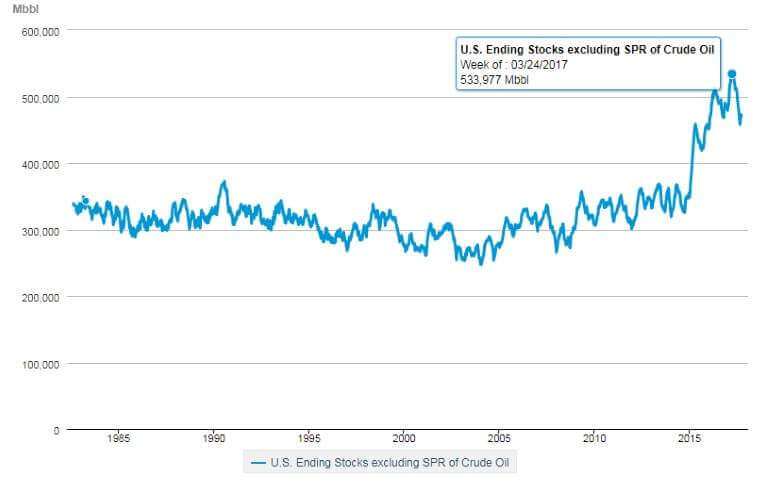
«Los inventarios comerciales de petróleo en Estados Unidos han caído desde los máximos alcanzados este verano, pero en las últimas semanas se han producido leves aumentos como consecuencia de la reactivación de la producción en los campos de Texas y otros factores relacionados con la demanda y las decisiones de las empresas.»

inventarios-petroleo-eeuu

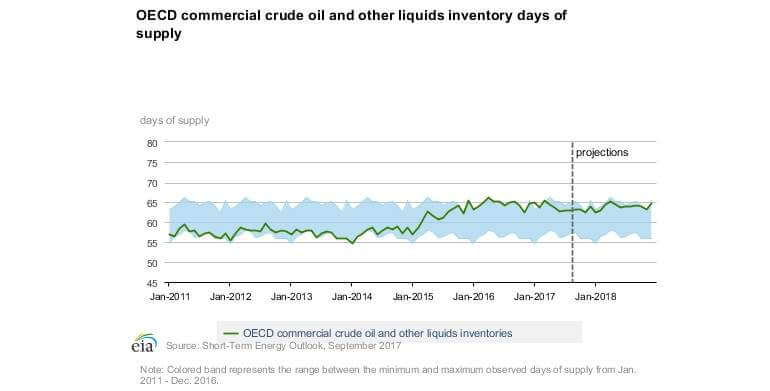
«Por otro lado, los inventarios de petróleo de la OCDE han pasado de representar 66 días de consumo del bloque a 63 días. Sin embargo, la Agencia de la Energía de Estados Unidos estima que estos inventarios vuelvan a cubrir unos 65 o 66 días de demanda en abril de 2018, lo que supondría que las reservas volvería a tocar máximos de los últimos años.»

oecd-commercial-crude

De Economía Hoy / VICENTE NIEVES – 5:47 – 3/10/2017